Friday, July 29, 2022

Letters of Basil Bunting Selected and edited by Alex Niven. #2


 The letters as biographical evidence;

‘Letters are meant to be written to affect one bloke, not a public. What is true in the context of sender and recipient may be a bloody lie in the context of author and public…’ (Bunting to Zukofsky, June 1953 qtd in Burton, p. 354)


What becomes obvious, when Bunting's letters are printed in full and in some kind of sequence, is how limited they are as biographical evidence.


A skilful biographer, like Richard Burton in his biography of Bunting, makes cautious use of letters as biographical evidence. On their own they don’t constitute biography. Something mentioned in a letter may be fictional; an absence in the letters doesn’t necessarily mean it’s absent from the life. Burton’s biography makes it clear that Bunting loved a good story and wasn’t above embellishing one to make it more interesting.


Before email killed it, letter writing was a performance art where content and expression were shaped towards the recipient.  Unless explicitly so, a letter wasn’t testimony delivered under oath, or an essay written for examination, despite the tendency of scholars to treat letters as both. The one letter in this collection, explicitly written ‘for the record’ is different in tone and syntax from the others. 


Bunting repeatedly told his correspondents that his letters were not written for publication or posterity: ‘None of what I write in letters is meant in any permanent way, it isn’t thought out or deliberated on. It is offered merely in passing, not meant to be dwelt upon’ (p.193).


It's a caveat worth keeping in mind. Thanks to Niven, interested readers now have access to complete letters, contextualised in the sequence in which they were written. 


The letters hint at biographical events for which there is no external evidence. ‘I am off for the continent, and I hope to be in Italy sometimes in the spring and I hope to visit Rapallo and I hope to meet you there. My Girl Died’ (p.24).


Niven can only note: ‘This curious elliptical aside ,-for which I can find absolutely no context-brings home how little we really know of the minutiae of BB’s early years’ (n. 67 p. 24). The same is true of Bunting’s strange claim to have led some kind of protest in London during the succession crisis.


Later in life, Bunting was adamant, in both letters and interviews, that Wordsworth had been a major influence on him from childhood. When Bunting discovered that Peggy Greenbank was still alive, he tells his correspondents that he had never not been in love with her. It would be possible to extract such statements as ‘evidence’, there is no reason to doubt him, but it’s now possible to see that neither claim is mentioned in any of the letters prior to the ones in which the claim appears (1953 and 1965 respectively). 


Whether this means the statements are ‘false’; demonstrates the limitations of letters as biographical evidence, or opens up the rabbit hole that ‘true or false’ might have different definitions in different contexts and is rarely a straight forward binary,  it’s now possible to ask those questions.  

Sunday, July 3, 2022

A reading of Jeremy Hooker's '1st of July 2016'


Clicking on the link below will take you to the poetry voice podcast. The poetry voice podcast is an audio anthology of poems from the earliest times to the present day. You can also listen to it on Apple Podcast as well as Spotify. This is episode 183. There is a complete index of all previous episodes  on www.liamguilar.com


www.liamguilar.com/the-poetry-voice/2022/6/30/jeremy-hookers-1st-of-july-2016


This poem is taken from Jeremy Hooker's collection 'Word and Stone' (Shearsman 2019)

Saturday, June 25, 2022

Letters of Basil Bunting. edited by Alex Niven


 Excited to finally get my hands on a copy of this. So far very impressed by Niven's editing, not everyone can do footnotes or annotations but so far his have been everything they need to be and nothing more.  

I'm  looking forward to reading several of these letter which i've only seen quoted with the inevitable critical ...


More to follow.


Saturday, June 18, 2022

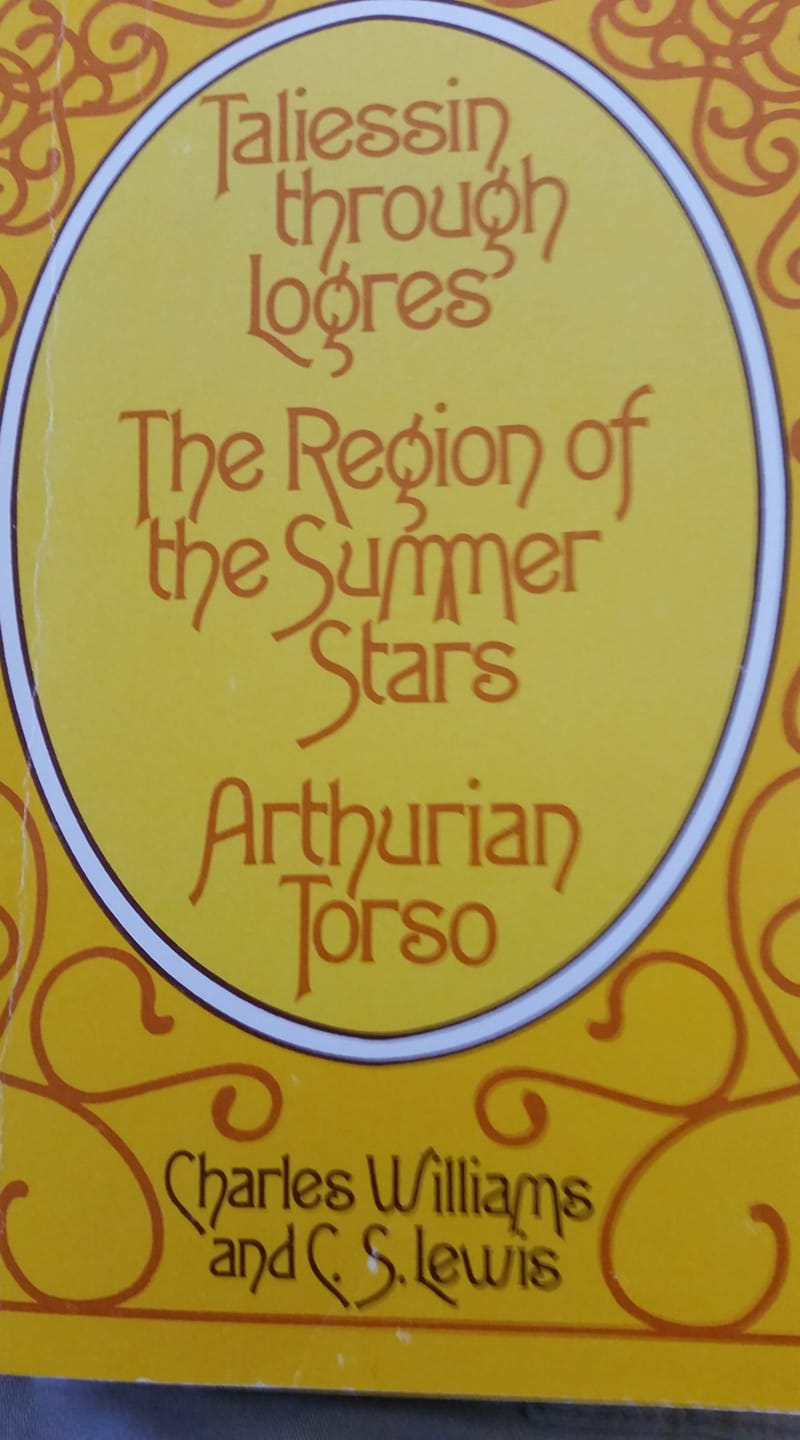
Gavel Lindrop on the excellence of Charles WIlliams' Arthurian Poetry


A lecture on Youtube, Gavel Lindrop's excellent consideration of the merits of Charles Williams' Arthurian poetry. He makes a case for Williams' stature as a poet, and for his important contribution to the Arthurian story.

It's a beautiful example of a critical intelligence in the service of the poet. It feels 'old fashioned' in the best of ways, rather than the critic using the poem as the starting point for a performance, the critic is trying to explain to an audience why a poet he admires is worthy
of their attention. 

https://youtu.be/eP9C7SaYEC8  


Monday, June 6, 2022

Publication: The story of Vortigern, Chapter seven.


Chapter Seven brings part one to a close.   You can read it by clicking on the link below. (The first picture above shows an Anglo-Saxon building reconstructed at the Experimental Archeology site at West Stow. The second shows looms in one of the buildings.)   


https://brazen-head.org/2022/06/05/chapter-7-the-good-old-days/

Thursday, June 2, 2022

Dumbing down Sir Thomas Malory's Morte D'Arthur.


This is from the publisher's summary for the Audible audio book version of Le Morte D'Arthur read by Chris MacDonnell and published by Spoken realms. 

It has to be a candidate for the title of 'Dumbest reading of the book' or 'How to misrepresent a book in a desperate attempt to attract readers'.

To the modern eye, King Arthur and the Knights of the Round Table have many similarities to our own contemporary super-heroes. Equipped with magical powers, enchanted swords, super-strength, and countless villains to take on, they protect the weak and innocent and adhere to their own code of honor. Comparing Batman, Superman, and Captain America to Sir Launcelot, Sir Tristram, and Sir Galahad isn't a huge leap of the imagination.

Perhaps, for the 15th century reader, King Arthur and the Knights of the Round Table were the equivalent of our modern day Justice League or Avengers.

There are so many things wrong with this description of the Morte and its readers that I wonder if the person who wrote it had read the book or knew anything about the fifteenth century.

It may not be a huge leap of the imagination to compare Captain America and Sir Galahad but it's a leap away from anything meaningful in the book.

Comparing Batman and Sir Lancelot is like comparing Napoleon and Brigitte Bardot: they have many similarities: they were both French, they both had hands, feet, a mouth and eyes.


My attempt to explain what is great about Malory, and why I've been rereading him since the 1970s, was published on the Brazen Head:

https://brazen-head.org/2023/06/27/thomas-malorys-civilisation-shaping-chivalry/ 


Thursday, May 26, 2022

Billy Mills reviews Maurice Scully's 'Things That Happen'

 As much as i love 'Things that Happen' I find it very difficult to say anything intelligent about it.

But you could read an excellent review by Billy Mills if you follow the link below:

https://ellipticalmovements.wordpress.com/2022/05/25/things-that-happen-and-airs-by-maurice-scully-a-review/