Showing posts with label reading. Show all posts

Thursday, May 15, 2025

From Base Materials by Jenny Lewis, a review of sorts.


 Jenny Lewis, From Base Materials, Carcanet, 2024

Well-written poems provide the pleasure that only well-written poetry can provide, a fact that sometimes get lost on a generation of writers who think that making declarative statements and chopping them into short lines constitutes the best that can be done with the art.

From a re-imagining of the Rubaiyat of Omar Khayyam, via  short illustrated poems reminiscent of Edward Lear, to the outrage and indignation that seethes through her poem for Sarah Everhard, the pleasure of reading Jenny Lewis’s From Base Materials comes from the excellence of its writing and the variety of its content.

Lewis’ previous book include an acclaimed version of the Epic of Gilgamesh and her translation of  Adnan Al-Sayegh’s Let Me Tell you What I Saw. The latter is a book anyone interested in modern poetry, especially long form poetry, should read. The former is the most readable version of Gilgamesh you’re likely to find.

While tightly themed collections of poems all on the same subject allow reviewers to sound profound and provide publishers, if they still publicise books, with snappy publicity shorts, the reading experience can be dreary. There was a time when books had titles like ‘New poems’ and ‘36 poems’. Poets are people who live in the real world, and the real world is various and as humans their reactions to it range widely so why shouldn’t their poems?

From Base Materials moves from the private-domestic, from personal poems in which the writer describes dealing with a mastectomy and the loss of friends, the reality of ‘love in old age’, the wit of ‘Tales from Mesopotamia’ where Gilgamesh’s barber and a street dancer are grumbling, to short translations, humour, moments of reflection and outrage.

 ‘Hearsay’ is a sequence of three short poems (38 lines in total) about Guinivere, Arthur and Lancelot and illustrates many of the strengths of the collection,

If poems are a way of thinking through and in language, then this sequence should offer both the pleasure of itself as a well-made verbal artefact, and comment on the story of Arthur and Guinevere.

The sequence might be asking: Who is Guinevere? In answer, it suggests there are only versions: she seems unsure of, or unhappy with, her identity, while both Lancelot, and Arthur are sure they know who she is, though their versions differ.

In the first poem, ‘Guinevere’, a restless woman, shifts amongst possible identities, waiting for the miracle of recognition.

The poem begins with subversion:  ‘like eve she names the birds/while waiting for miracles’. In the Christian tradition, Eve does not name anything, nor did she wait for miracles. An Eve who did these things would be rebelling against her traditionally assigned role.

However, the line refers to another poem in the collection, ‘As Adam lay sleeping’. Two pages earlier it ends: 

where she, hearing clearly for the first time
the tumultuous singing of the birds,
could set about the task of naming them.

Between ‘As Adam Lay Sleeping’ [with its possible acoustic nod to the repeated line in Kipling’s  ‘Four Angels’] and ‘Hearsay’ is ‘Therefore all seasons shall be sweet to thee…’ dedicated to ‘Eve, born 6 January 2020’, which ends with the poet describing her wishes for the newborn.  The title, as the poem acknowledges, is a line from Coleridge’s ‘Frost at Midnight’.

The sequence ‘Hearsay’ is itself part of a sequence, gaining meaning from other poems in the book, and gaining power by drawing on the wider poetic tradition.   

The birds Guinevere names: ‘owls, peacocks, ptarmigans, doves- ‘ provide a shifting set of possible roles which can only ‘brush against her thoughts’. The list, suggesting restlessness or uncertainty, is followed by suggestions of unhappiness. 

While waiting for miracles, she is ‘polishing the round table, wanting praise.’

A literal reader might object that queens don’t polish tables. But there is a tradition of stories in which queens and princesses are punished by being forced into menial labour or into roles that are at odds with their status. In these stories the essential identity of the woman is either not recognised or not given its due. Here the queen is ‘wanting praise’. Wanting in both senses, lacking and desiring. The phrase suggests her dissatisfaction with her role, with actions that are not in keeping with her sense of her own identity, and explains why she is waiting for miracles.

She does ‘polish’ the Round Table. She brings grace to the gathering and gentles an association of expert killers. She feminises the knights. But that turns her into an adornment, something less than an individual. The fact she wants praise suggests something too about her husband’s attitude. Polishing the table in this sense is a useful activity, but the fact she keeps doing it over and over again suggests no one appreciates her efforts.

In the bath she is ‘angelic, pure, mother of pearl with light bursting from her’. Still not human. As her lover removes his armour piece by piece, ‘the naked hand that held cold steel finds/the warmth of her bird filled body’ while Arthur looks away and sees snipe and plover fall into the net.

Arthur ‘looks away’. Is he looking away as the lovers meet, or is he just watching something else. One of the questions in Malory’s version of this story is at what point does Arthur know his wife is having an affair? The second poem of the sequence, ‘Windhover’, describes the moment he realises the rumours are true.

Like many in the collection it’s a technically impressive poem, and like so many of the poems it draws on literary tradition. While windhover is a dialect name for a kestrel, it’s also the title of one of Gerard Manley Hopkins most famous sonnets. Not only has Lewis used Hopkins title and rhyme scheme, her lines end with the same words as Hopkins’, with one exception, where sillion has been replaced with stallion. The swing and swerve of the world Arthur is looking at is mirrored in the rhythm of the first eight lines.

Such technical excellence is impressive, but on its own it suggests the workshop exercise that proves little but linguistic virtuosity. The question that often goes begging is ‘to what purpose’? Here it suggests Arthur’s complicated relationship with his wife. The sense of awe that pervades Hopkins poem carries over to Arthur’s thoughts about her. But whereas Hopkin’s poem celebrates the glory of creation made specific in a single bird, who masters the elements around it. Arthur is locked into the rhyme scheme of his own misery and his vague awareness of clouds and nameless birds can’t save him from the thought of his wife and friend. Hopkins’ poem also ends;

No wonder of it: sheer plod makes plough down sillion
Shine, and blue-bleak embers, ah my dear,
Fall, gall themselves, and gash gold-vermilion.

There’s no sense of this transformation into beauty here.

He is out riding. The same clouds Guinivere saw from her bath in the previous poem, ‘like scarves stretched  by the wind’ he only sees as ‘a sky full of clouds’. The poem captures the moment when he knew ‘what his heart had been hiding’….that what ‘they said about her must be true’.

Lancelot, riding on a white stallion, [Arthur’s mind slipping on the crude connotations of riding so close to white but saved by stallion instead of mare] has taken away his dear ‘his lady her raven locks her white body and her lips that burn vermillion’. Unlike Hopkins who labours to capture the singularity of a specific bird, if Arthur sees Guinevere at all he only sees surface. Lancelot has not taken away a friend, or a lover, just a ‘dear’ [with its double meaning of object of affection and something expensive] collection of cliched body parts which do not individualise her but reduce her to type. The woman with lips redder than blood, hair darker than the raven’s wing, skin whiter than the snow is today a figure familiar in fairy tales but goes back to medieval times. Such women are also often tragic figures or participants in a tragedy.

The last poem is ‘Falconer’.

He only saw her whiteness, I

saw her as brindled, wild

            like a spirit you call in

across the darkening fields,

I watch her stoop, then come

            to me with flying jesses

her ferocious eyes unhooded

            unerringly mine.


While the pronouns in the first line are unattributed, it’s logical to think ‘he’ is Arthur, who mentions his wife’s ‘white body’. The /I/, presumably Lancelot, sees a different version of the woman. [If this were a stand-alone poem the /I/ becomes far more ambiguous and could be both Lancelot and the poet.]

The first line is a criticism of Arthur’s inability to recognise his wife. For Lancelot, she is ‘wild’ ‘a spirit’ her eyes are ‘ferocious’. She is not soft, or prey but predator. Rather than white, he describes her as ‘brindled’, which might be an odd word to describe a woman, since the dictionary associates it with cats and fur, but it is a word Hopkins used in another famous sonnet, ‘Pied Beauty’ which begins:

Glory be to God for dappled things – 
For skies of couple-colour as a brinded cow; 

That poem celebrates:

All things counter, original, spare, strange; 
Whatever is fickle, freckled…


Lancelot recognises a version of Guinivere that is perhaps more nuanced than Arthur’s doomed fairytale princess. In her meeting with him her eyes are ‘unhooded’…both the falcon whose hood is removed to let it hunt, and the woman who no longer has to pretend. Does he see her as ‘counter, original, spare, strange’?  Has she achieved the kind of life the poet wishes for Eve at the end of ‘Therefore all season shall be sweet to thee…? Lancelot and Arthur both seem to have found themselves, like Adam in Kipling’s ‘Four Angels’;

Till out of black disaster
He arose to be a master
Of Earth and Water, Air and Fire,
But never reached his heart's desire!

The words in ‘Falconer’ undermine any temptation to accept the final poem as a description of Guinevere’s ‘true nature’. He’s not thinking of her as an individual woman but as a hunting bird. By the end of the sequence, she’s still not free, still defined by her relationship with a man. If she’s the falcon and he’s the falconer, however wild the bird, she has been tamed; she can be ‘called in’. He can proclaim she is ‘unerringly mine’. She isn’t even one of the birds she named. Someone else has named her.

Does she love Lancelot because he sees her as she is? Or does he simply offer her a miracle of limited recognition, an improvement on her husband’s inability to notice her? If so it seems a limited improvement. Beyond this, there is a suggestion that their relationship is dangerous to both of them. The contrast is between a spirit that is wild, and one that can be ‘called in’. Restrained, limited. Brought back to its owner. While the phrase ‘she stoops’, beyond its technical meaning in falconry, and the sense of the bird falling towards the thing it will kill, has an inevitable resonance with the phrase ‘She stoops to conquer’ [a phrase which has floated free of its origins to mean something more threatening], suggesting Lancelot’s self-confidence might be misplaced.  

Reading ‘Hearsay’ like this is not meant to be exhaustive or definitive. But hopefully it suggests some of the qualities of the verse in From Base Materials and the pleasure of reading it.

From Base Materials is an impressive collection. You should read it.

Thursday, April 17, 2025

Why read 'literature'. The Pope's answer

 Leaving aside the problem of defining 'literature' as against 'books'.

I've heard and read many claims for the power of literature over the years. As an English teacher one can't escape them. But one of the most rational is the Pope's, in his 

LETTER OF HIS HOLINESS POPE FRANCIS
ON THE ROLE OF LITERATURE IN FORMATION

which you can read in full by clicking on the link.

It's a year old. And his Holiness is addressing the role of literature in the training of priests, but what he says seems valid  even if you aren't a believer. 

At a time when banning books, or at least objecting virulently to those that show behaviours or beliefs people don't like, or censoring or rewriting books where characters speak or act in ways that are 'unacceptable' for one reason or another to somebody today, the Pope's letter offers a [?surprisingly?] different approach.  These three paragraphs stand out for me:

38. Literature is not relativistic; it does not strip us of values. The symbolic representation of good and evil, of truth and falsehood, as realities that in literature take the form of individuals and collective historical events, does not dispense from moral judgement but prevents us from blind or superficial condemnation. As Jesus tells us, “Why do you see the speck in your neighbour’s eye, but do not notice the log in your own eye?” (Mt 7:3).


39. In reading about violence, narrowness or frailty on the part of others, we have an opportunity to reflect on our own experiences of these realities. By opening up to the reader a broader view of the grandeur and misery of human experience, literature teaches us patience in trying to understanding others, humility in approaching complex situations, meekness in our judgement of individuals and sensitivity to our human condition. Judgement is certainly needed, but we must never forget its limited scope. Judgement must never issue in a death sentence, eliminating persons or suppressing our humanity for the sake of a soulless absolutizing of the law.


40. The wisdom born of literature instils in the reader greater perspective, a sense of limits, the ability to value experience over cognitive and critical thinking, and to embrace a poverty that brings extraordinary riches. By acknowledging the futility and perhaps even the impossibility of reducing the mystery of the world and humanity to a dualistic polarity of true vs false or right vs wrong, the reader accepts the responsibility of passing judgement, not as a means of domination, but rather as an impetus towards greater listening. And at the same time, a readiness to partake in the extraordinary richness of a history which is due to the presence of the Spirit, but is also given as a grace, an unpredictable and incomprehensible event that does not depend on human activity, but redefines our humanity in terms of hope for salvation.

Saturday, August 31, 2024

Is this how Genre works? The tale of the oldest animals in Culhwch and Olwen.

 (Ongoing notes from an attempt to translate Culhwch ac Olwen from medieval Welsh to modern English and from prose to verse. See previous post for an example. )

In 'Culhwch and Olwen' there's the 'Tale of the Oldest Animals' which I've just finished drafting. You have to accept animals can talk and people will understand them. But....the story itself...

Arthur and his men need to find Mabon mab Modron. To do this, they have been told that first they have to find his cousin, Eiddoel mab Eri. They find Eiddoel easily enough, he's being kept prisoner in a place called Gliui by someone with the same name.

Gliui is identified by the editors as Gloucester. Fair enough. Later, after a trek from one 'Oldest animal' to an 'Even older animal' our heroes discover Mabon is being held prisoner in Kaer Loyw, which the editors also identify as Gloucester. 


So they free Eiddoel from the same place they free Mabon, though they go round the Wrekin to achieve this. 

Does genre work by setting up a tacit bargain with the reader: Some questions are inappropriate? If for general example, you're reading the Grimm's version of Snow White you should not stop and ask what the prince is going to do with the dead girl in the glass coffin when he gets it home. Nor should you try and imagine his arrival at the palace and his parents' reaction. It will kill the story.

Inappropriate, unanswerable questions here?

How can they both be prisoners in the same place? Who is keeping Mabon prisoner? Presumably it’s not Gliui because he's offered Arthur his help and support? Was he lying? Is Arthur at fault for not asking if Gliui knows where Mabon is? Why do they assume that 'No one knows where Mabon is' means 'Don't ask anyone except an animal'? Why does no-one on the river hear Mabon lamenting?  Why have they been told they needed Eiddoel to find Mabon when he is sent on the search but contributes nothing to it? 

Why is the episode so satisfying and enjoyable until you start asking these questions? And this is true of so much of Culhwch ac Olwen. 


Are we back with a specific version of Culler's 'Literary Competence'. The idea that you have to learn to read a literary text as a literary text on its own terms? And with this story, that means not trying to read with a modern set of assumptions based on a learnt 'Literary competence' for dealing with modern short stories or novels? 

Thursday, May 9, 2024

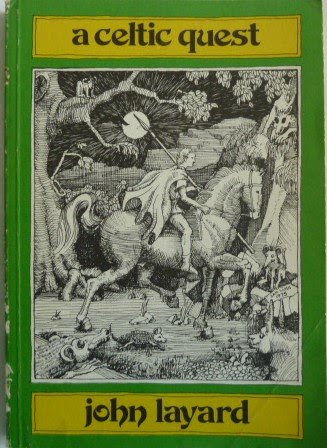
A Celtic Quest, by John Layard. A review of sorts.


A Celtic Quest. John Layard 1975.


In my last post I praised ‘This is not a Grail Romance’ for attempting to read a medieval story on its own terms. John Layard’s ‘A Celtic Quest; Sexuality and Soul in Individuation. A depth-psychology study of the Mabinogion legend of Culhwch and Olwen’ is a fine example of what happens when a critic does the opposite, taking a text and imposing a reading practice on it.


As a demonstration of a psychoanalytical meditation on a text, the book is fascinating. As one way of thinking about the development of an individual, it is coherent and thought provoking. But I think it would work best if you haven’t read the story it claims to be studying. 


As a reading of the text, rather than a performance that uses the text as a starting point, it doesn’t offer much in the way of critical enlightenment. It suffers from the author’s wide knowledge of what something might mean and his assumption that because something might mean something in another story, it means the same thing in this one. His willingness to shoehorn the story into an existing theoretical paradigm requires a willing suspension of incredulity on the part of any reader who isn’t a card carrying Jungian. 


Ironically  I suspect the book’s value may lie in forcing a reader to be patient and negotiate the tension between the reading and the text. The struggle to suppress the temptation to throw the book away, and find some useful insight into the story is salutary.


Firstly, a reader has to suppress the urge to object to statements like this:

 “’Born in a pig run’ is equivalent to being ‘born of a sow’ (p.11.).’ No. Simply, no, they are not. Culhwch’s mother is most definitely not a sow. 


Secondly. Anything can symbolise anything. Freud’s great perception about dreams was that the symbolism is always specific to the dreamer. This seems a useful way of approaching symbolism in stories. It’s not Layard’s. He is wedded to the idea of archetypes. He reads the story as though it could be neatly analysed and explained by recourse to an old fashioned book of dream symbols.


When Culhwch and his companions find Custennin the shepherd, the latter is sitting on a mound overlooking his limitless flock of sheep: 

‘…he is a man in the service of the Devouring mother, since in dreams and mythological imagery, the mound he stands on would seem to symbolise the breast’ (p.38)


At times this borders on self-parody. When Olwen’s father is finally beheaded and his head stuck on a stake; 

‘Another aspect of body imagery is that it may be that the mound symbolises the breast, with Ysbaddaden’s head on it  stake representing the ‘bad nipple’ . The hero seizes the good one ‘And he took possession of his fort and his dominions’.; the fort of the breast and the immense power it wields.’(p.198) 


With all due respects, this is hard to take seriously. There is nothing in the story to suggest ‘the fort of the breast’,  and this in a story where the storyteller delighted in playing with the potential absurdity of names.  Culhwch does not take possession of ‘the fort and his dominions'.  The ‘he’ in that sentence refers to another character, Goreu, who is also the one who beheads Ysbaddaden.


It feels as though symbolism is being found everywhere for the sake of finding symbolism with little reference to the story. When Cei murders Wrnach the Giant, having first tricked the giant into giving him his sword, Layard writes:


‘The scabbard here stands for the giant’s muddled head, into which Cei plunges the sword. The sword also symbolises the power of insight (the Logos) that pierces and destroys the blind forces of darkness (the blackness of the giant) or of the unconscious super-conservativism and resistance to change that giants are apt to represent.’ (p.102) 


Faced with such a reading it seems almost pedantic to point out that Wrnach is not described as black or back haired. But it does seem to be a worth asking how this applies to the story. Who gains what insight? Wrnach is dead, and Cei is about to leave the story in a fit of petulance after Arthur teases him. 


How the reading applies to the story is a constant question. Most readers will see Culhwch’s stepmother’s actions as wilfully (perhaps spitefully) putting him in danger. When she says he will not marry any woman unless it is Olwen, the phrase she uses  ‘ Tygaf tyghet’ is glossed by Bromwich and Evans as ‘I will swear a destiny’ and they point out the same phrase is used by Aranrhod, in the Fourth Branch of the Mabinogi,  when she swears her three [debilitating] destinies on her own son, Lleu. As Culhwch soon finds out, no one asking for Olwen’s hand has escaped alive. 


However, for Layard: ‘stepmother and fairy god mother are thus seen to represent two aspects of the same female spiritual principle, at first appearing to be 'bad’ but turning into the ‘good’. Such will be seen to the nature of the stepmother in this present tale, who in fact causes the hero to undertake all sorts of fearsome tasks so as, in the end, to win the prize most worth having, the spiritual bride or soul’.  (p.13). 


It feels pedantic, again, to point out that Culhwch doesn’t complete ANY of the forty tasks he’s given. Other people do it for him. He earns nothing, and learns nothing. He isn’t so much a non-hero as a non-presence in most of the story. The paradigms of the fairy tale or the ‘hero journey’ are not helpful here and what fairy godmothers and step mothers do in other tales seems irrelevant. 


These are not isolated or uncharacteristic examples but I think they demonstrate how a reading practice is being imposed on the text. 


Like most reading practices it also requires the reader to accept the critic’s assumptions: in this case those underwritten by a Jungian Binary, which in a simplified form, wants  to divide everything into two columns, one marked ‘male’ and the other ‘female’, regardless of gender or actions in a story. The Twrch Trwyth, the terrifying wild boar who slaughters men and devastates provinces, who can only be hunted by the mustered warriors of three kingdoms: 

..’is the image himself of nature outraged at having to be transformed, female in origin but in male guise to indicate its wild destructiveness’. (p.11) (The TT is a King who God has turned into a boar for his sins, and the aim of the hunt is not necessarily to  kill him, but to seize the comb, razor and sheers from between its ears.)


The binary is 19th century and to non Jungian acolytes completely arbitrary. Things are masculine or feminine because someone said they were. ‘Magic is always feminine” … and “…thought is a masculine attribute which women can have as well as men (witness the stepmother) once they admit the man as mate and not only as son’. (p.197)


Her husband is murdered so she can be the second wife of Culhwch’s widowed father. Her speeches in the text do not suggest ‘thought’ or that she has any attitude towards her new husband except relief to find he isn’t impotent.


Culhwch and Olwen is one of the world’s great literary performances. In its entirety it is like no other text. It is full of inconsistencies, and lacking in what a modern reader might expect in terms of character development and plot. It is not a fairy tale. But Leyard’s treatment of it as though it neatly illustrates a Jungian approach to Individuation, ignores the story itself and becomes an excellent example of what happens when a modern reading practice is imposed on a medieval text. 


Thursday, April 25, 2024

This Is Not A Grail Romance. Natalia Petrovskia a review of sorts


This Is Not a Grail romance: Understanding Historia Peredur uab Efrawc.  Natalia l. Petrovskaia . University of Wales Press, 2023. 


 'If the material before us fails to conform to our present-day European concepts of logic and unity, perhaps instead of rejecting the text should reject the logic and find a new one'. (Llyod-Morgan. Qtd page. 15).


Beyond its value to students of the Welsh story, this book demonstrates the value of approaching a medieval text, not with the assumption that it is a flawed attempt at a modern narrative, but as an attempt, not so much to read it on its own terms, but to discover what these terms might be. 


Background.

The default approach to medieval texts is to see them as clumsy approximations of modern literature. To be sure there are 'works of genius' but 'Chaucer would be so much better without the digressions'. 

There are two strands to this approach which start at the same point but head in different directions. In one the 'literary flaws' of the text are enumerated. The lack of coherence, of character development, the digressions, the absence of a proper narrative arc, are all pointed out. The Writer is like a child who is trying to do something that is beyond him or her. Nice try, but...

The second approach, specific to this topic, is the one which sees the Welsh prose stories collected as 'The Mabinogion' as incoherent. The writer didn't understand or wasn’t in control of the material, the stories are the ruined, garbled remains, of lost precursors. There is a critical tradition in which the scholar, having  identified the incoherence, attempts to recreate the original, coherent, story.  Given such stories no longer exist, the reconstruction usually says more about the scholar than the story.

Both approaches are underwritten by the idea that literature is an organic entity subject to Darwinian evolution, and after the high point of Greek and Latin literature,  the awkward fumbling of the medieval Makar are the clumsy beginning of a progression which improves over time to whatever you currently think of as excellent.

This is both highly patronising to the creators of our texts: if only they'd have been to a modern writing workshop they might have done better, and insulting to their audience who were obviously willing to put up with any kind of rubbish because evenings were long and Netflix hadn't been invented.

But it  shuts down a proper consideration of medieval storytelling. It's not possible to learn from something that’s already been dismissed as inadequate.

End of background


So here's to Natalia Petrovskaia, and her willingness to treat Peredur on its own terms. Her analysis of the structure seems to prove that this is not just a random accumulation of events but a carefully built story working to its own rules. 


Her argument is based on the recognition that there are two surviving versions of this story.  The Short Version, which owes little to the French, and the Longer Version or Short Version +Continuation. The latter is what modern readers encounter in a translation of  ‘The Mabinogion’ and it is incoherent, inconsistent and repetitive.  


By focussing on the shorter version, which is the oldest surviving version,  she rejects the idea that Peredur is a badly written single narrative. She argues that the short version is three distinct stories, self-contained, which are linked by being about the same hero. The key is that the individual episodes ‘can be taken not merely as episodes in a grander narrative, but as complete semi-independent narratives forming distinct units that can be removed, replaced and re ordered. Most importantly, there are no internal contradictions or inconsistencies within each of these units.' ‘Any inconsistences that can be found (eg. the seemingly ever changing object of Peredur’s affections) are to be found between these episodes, not within them. '


She refines her argument to see the story’s organisation as a fractal structure,  specifically a Sierpinski gasket. This fractal model offers a mnemonic structure for the story teller: Three episodes, each composed of three sub episodes, each involving three consecutive scenes of encounter. 

Part of her argument reminds me of  Carol Braun Pasternack's arguments about the 'Movement' nature of Old English Poetry, and while that leap is mine, not Petrovskaia's, it adds weight to her argument.  

The coherence of her model would seem to prove her point as does the experience of rereading the story after reading her book.


Secondly, her argument that this is not a Grail Romance seems incontrovertible. Perdedur is not shown a Grail or does he seek one. (Hands up those who, like me, first read it as a Grail story because they had been told it was, and wondered what they'd missed.)


Thirdly this is not a Romance in the generic Medieval meaning of that term. 


We read in ways we've been taught. Our reading practices shape not only our responses to texts, but create the texts themselves. Modern reading practices get in the way of our engagement with medieval stories.  Rather than treat each text on its own terms, the critic and reader try to fit the text into learnt patterns based on teaching and prior reading. When a text doesn’t fit the pattern, it, rather than the pattern, is found wanting. Christopher Cannon made this point brilliantly in the context of post-conquest English literature in 'The Grounds of English Literature'. But it's a point that needs repeating. 


There are other arguments in the book. Whether the landscape of some of the episodes can be linked to specific places and the story contextualised geographically is a moot point. Certainly a Welsh /Border landscape supports the argument about the Welshness of the story. However while Identifying a specific castle by a convent where the Nuns are in poverty is difficult, the fact that the attempt is possible reinforces the idea that the original audience would have felt these landscapes familiar and plausible in ways a modern audience can’t.  


The Welshness of the story has been argued over. Petrovskia makes a sound argument that what she calls the 'Short Version' originated in Wales, and not as an attempt to copy a French original. 

Her conclusion:

This is not a Grail Romance nor is it  a Romance. Peredur is not a single narrative but carefully built episodes. 

What she designates as Episodes 1 to 3 not only show no trace of stylistic incompetence, but  demonstrate structural virtuosity; are anchored in Welsh historical, literary, legal and cultural contexts, and originated in Wales.  


Short, clearly written, carefully argued,  beyond its value to present and future students of Peredur Vab Efrawc, it is a demonstration of the benefits of approaching a  story with the assumption that the text is the way it is because someone who knew what they were doing made it that way for people who enjoyed and appreciated the end product. 


Friday, January 5, 2024

The Buried Giant by Kazoo Ishiguro. Puzzling over value. Literary Allusions.

The Buried Giant Kazuo Ishiguro. Faber  2015


‘The Romans have long since departed, and Britain is steadily declining into ruin.’ Blurb.


Discussions of literary allusions usually disappear into theories of intertextuality, rather than discussions of the effects specific examples have on the reading of a particular text. 

The Buried Giant is a good example of conscious intertextuality, where elements of the story are deliberately waving in the direction of any number of famous texts. 


A Saxon warrior brandishes his trophy: ‘…what they were looking at was not a head at all, but a section of the shoulder and upper arm of some abnormally large, human like creature.’(p76). In case the reader misses the reference, a character explains: ’Our hero killed both monsters. One took its mortal wound into the forest, and will not live through the night. The other stood and fought and for its sins the warrior brought of it what you see on the ground there. The rest of the fiend crawled to the lake to numb its pain and sank there beneath the black water.’ (p.76) 


A Saxon hero, two monsters, one with its arm ripped off sinking into the black water. Minor variations, but too close to Beowulf to be anything else. Later, the same hero will go into combat with a dragon. But if Beowulf is being alluded to, knowing the poem adds nothing to an understanding of The Buried Giant, and The Buried Giant doesn’t offer any kind of insight into Beowulf.


While our Saxon hero points pointlessly towards a specific text, there are other examples where so many allusions are in play the result seems self defeating. There is a knight called Sir Gawain, a recently dead king called Arthur, a magic wielder called Merlin, there are wild women to be met on a blasted plain, a dragon to be killed….but what are all these allusions doing? Instead of adding significance, the ceaseless, enthusiastic pilling up of literary references empties the words of meaning. 


All the aging Sir Gawain has in common with the hero of Arthurian romance is the name. A cross between Don Quixote and one of the Knights Alice meets in Through The Looking Glass, who just might also have spent time in Browning's Child Roland. He is every literary Knight and no one in particular.


Arthur was a gift to medieval storytellers because he provided them with a ready built story world. And the basic outline of the story, established by Geoffrey of Monmouth, gave the world a beginning and end. But since Arthur became a character in modern films and fiction, the Arthurian story world is no longer coherent. Gesturing towards it gains the writer nothing. There are so many characters called Arthur, in so many divergent versions of ‘his’ story. The recent film ‘King Arthur: legend of the sword’ could have been called King Bob and his magic stick. Prior knowledge of King Arthur is of no help in understanding either that film or The Buried Giant. 


The allusions do create an air of familiarity.  A post ‘Arthurian’ world of villages and knights, Britons and Saxons, evil lords and inevitably crazy sado-masochistic monks. But nothing in the story alludes to anything specifically Arthurian except the names. The king could just as well be Good King Billy Joe Bob. Sir Gawain could be Barny, Billy Joe Bob’s nephew. Change the names, leave the story set in a fantasy world set in pseudo medieval times, and lose nothing.  It would still be a fine story. It just wouldn’t feel quite so superficially self-consciously ‘literary’. 


The Beowulf character Saxon tells his apprentice that the stone monastery was once built by Saxons as a defensible hill fort, which includes an ingenious stone tower to trap the attackers. If this is immediately post Roman Britain, then the Saxons didn’t build in stone until very much later.


The Saxons and Britons could be Twiggles and Boggles. The story world would then create and define the Twiggles and Boggles. Instead nothing in the story distinguishes them, they are labelled Saxons and Britons, but they have very little, if anything, to do with any meaning those words have outside the story in either history or literature.


The Arthurian/Beowulf background is short hand wall paper, a cheap set dressing, not to be taken too seriously, not to be examined too closely. It gives the book a ‘literary air’, in which the writer shows off his reading and a certain type of reader gets to feel literary because they recognise the texts. But the names and the words have been emptied of meaning. They point everywhere. They are full of sound and fury, signifying nothing.


Monday, July 10, 2023

Transformation, magic, the conception of Arthur, a digression.


At some point, things that people accepted as real pass into their stories, and survive only as ‘something that can happen in a story’. The idea that human beings could transform, or be transformed, into other humans or other animals, seems to have been almost universal. But gradually the idea passes into the world of the storyteller. 

This doesn’t happen at a specific time in a culture’s history. And it happens at different times for different groups and different individuals within the same culture. If you are one of those who believe in the ‘contextualising of texts’ to identify ‘values and attitudes and beliefs’ this should make you reconsider what you’re doing. 


The stories in The Mabinogion were written down in the 14th century.  


in 2023 Amazon is selling books of magic spells, and if the reviews are anything to go by, people not only buy them but expect them to work. ('Where am I supposed to get wolves teeth?' asks one reviewer.) 


A very tentative google search reveals that on Fiverr I can hire a powerful practitioner of black magic (his sales pitch) to cast a transformation spell for less than ten dollars. For fifty dollars, another expert will transform anyone into a physical beauty. 


Astrology is still popular, not just in the free versions that turn up in most papers, or online, but in versions that require payment for a horoscope. Tarot readers flourish.


So before tracking ‘contemporary’ attitudes to magic and transformation, and puzzling over what it means to ‘believe a story’, it’s worth pointing out that while the stories in the Mabinogion were written down in the 14th century, a belief in magic is not something that disappeared from our society at some vague point in the past. 


Monday, August 29, 2022

Robert Graves, Poetic Unreason and reading The Tempest.

This began as a contemplation of John Kerrigan’s “Shakespeare’s Originality’ (2018) and my intention was to compare Kerrigan’s chapter on The Tempest, as an example of his overall argument and approach with that of Robert Graves in ‘Poetic Unreason’ (1925). But given how obscure the latter text is, what follows is an extended discussion of Graves’, ‘The Tempest, an Analysis’ (pps. 221-232).


A slight though not inconsequential digression


Eliot vs. Graves as critics.


Eliot. 'Hamlet', in ‘The Sacred Wood’ published in 1920.


‘The only way of expressing emotion in the form of art is by finding an ‘objective correlative’; in other words, a set of objects, a situation, a chain of events, which will be the formula of that particular emotion: such that when the external facts, which must terminate in sensory experience, are given, the emotion is understood.’ (p100)


The younger Eliot was good at smoke and mirrors. If you try to untangle the difference between an ‘objective correlative’ and a symbol, or you ask how any ‘external fact’ can objectively represent something as messy as an emotion in a way that will be recognisable to everyone, you may wonder what happened to his philosophical training.  It sounds profound and reasonable…until you stop and think it through.


But in his early criticism Eliot often withdraws from specifics. In the same essay he writes:


‘We must simply admit that here [in writing Hamlet] Shakespeare tackled a problem which proved too much for him. Why he attempted it at all is an insoluble puzzle. Under compulsion of what experience he attempted to express the inexpressibly horrible, we cannot ever know’.


Eliot is happy to raise a question and then avoid the necessity of offering an answer. It also absolves him from grounding the claim in any kind of evidence. Eliot’s essay is based on the assumption that ‘we’ all agree that Hamlet the play fails because Hamlet the character experiences an emotion in excess of the facts that might be used to explain or cause it. Whether ‘we’ would all agree with this, given the opportunity to dissent, is a different matter. Having damned the play, on grounds that are themselves questionable, it is enough for him to suggest that Shakespeare was driven by a personal compulsion to create Hamlet, and the play is a failure because he had not mastered that compulsion. But to understand that process ‘we should have to understand things which Shakespeare did not understand himself’. 


Eliot is a fascinating critic to read if you want to learn how to sound profound. And he has been fruitful for generations of literary critics because of what can be said about what he ‘meant’. There are versions of his essays, in the writings and lectures of his exegetes, which are far more interesting than anything he ever wrote. 


Graves on the other hand is fascinating to read for other reasons. He would probably have agreed with Eliot that the writing of Hamlet, or the writing of any play, was Shakespeare’s attempt to solve some kind of personal problem. At the time Eliot was writing The Sacred Wood, Graves was working towards a theory of composition that appears first in ‘On English Poetry’ and is then given its fullest expression in ‘Poetic Unreason’. Eliot claimed that to know why Shakespeare took on Hamlet would require ‘a great many facts in his biography, and we should like to know whether, and when, and after or at the same time as what personal experience he read….’. Eliot stops there. Having raised a question which he says cannot be answered, he exits, leaving us to wonder what was the purpose of his essay.


It’s a style that has been endemic in critical studies since then. The fashion for ‘problematizing’ texts was characterised by the failure of a many of its practitioners to do more than point out the problem. Graves, on the other hand, having come to a theory of composition, was more than ready to not only point in the direction he thought the critic should head, but to march resolutely towards his objective and persist in the assault long after common sense suggested that the objective wasn’t worth the effort. But his refusal to fudge the issue and stop becomes a way of showing why going half away along the path is equally pointless. 


‘Poets are entitled to approach the truth imaginatively as well as by the slower methods of scholastic research.’ (p91)


To understand the composition of any text, or in this case the play: ‘The easiest approach to the study of the composition of The Tempest is to sort out what has already been discovered of the contributory materials and then see what is left to be explained both of the materials and of the motives’ (p.194)


Graves states that there are three main sources which he seems to assume are well known. A German play by Ayrer, Die Schone Sidee

A Spanish Romance by Ortunez de Calohorra: Mirror of Princely deeds and Knighthood, translated and printed in 1580. 

A ‘fairly large body’ of literature dealing with adventure in the new world. (p.194)


For the modern reader, confronting the RSC Shakespeare’s declarative ‘No known Source for the main plot’ this raises immediate questions which we shall blithely ignore. 


Graves claims that once these three sources have been fused by the writer there is not much to account for: The masque, the drunken sailors, Caliban and his mother.


And off Graves sets to ‘account for’ these, like Alice chasing the White Rabbit. First, he constructs a biographical narrative from the sonnets, links this to the chronology of the plays, and goes on to show how The Tempest is Shakespeare’s attempt to reconcile the conflicts these personal disasters caused. The necessary catalyst that brings together the Author’s life and his reading was, according to Graves, a passage in Isaiah in the Bible. ‘Nobody familiar with the psychology of romantic creation should deny that this passage had the power of crystallizing into dramatic form all the loose material floating about in Shakespeare’s mind’. (p. 210) 


Perhaps I am unfamiliar with the psychology of romantic creation, but it seems to require a great deal of charity to follow Graves at this point. I can’t see the link between the biblical passages and The Tempest.


However, he goes on to ‘account’ for the features of the play that are not in the sources. 

Caliban is W.H.; Sycorax the Dark lady; Ariel is an emanation of Shakespeare himself. The drunken sailors discover themselves as Chapman and Jonson, rival poets. (214)


Graves was nowhere near finished. Ariel’s song ‘Full fathom five’ and Prospero’s Epilogue have also to be ‘accounted for’, and even then he keeps going. Contacting a scholarly expert, to check his findings, he discovers he needs to add the ‘recent’ murder of Henry IV and the marriage of both Shakespeare’s own daughter and the marriage of the daughter of King James. In this historical doubling Sycorax now ‘in the political sense’ is Catherine of Medici and Caliban is Jesuitism. Prospero as ideal King is both Henry 4 of France and James 1 of England, and Graves’ scholarly source provides supporting evidence that the other subsidiary character have political sources and the lengthy conversations amongst the stranded nobles have political overtones.


By which point the exhausted reader is beginning to wonder what doesn’t relate.

Caliban may well be the result of combining ‘An Adriatic devil from a Spanish romance, a sea cow seen in the Bermudas, Jesuitism generally; Raviallic particularly’ as well as Mr. W.H.  Everything a writer does, sees, hears and reads, is material for the finished work. It’s to Graves’ credit that he keeps going, but his determination illuminates the inevitable futility of the activity. Anyone trying to unravel all the threads that combined in the finished work is taking on an impossible task. A task made even more complicated by Graves’ understanding that, ‘How far he [Shakespeare] knew after writing each scene what that scene was about …is impossible to say’. 


The chapter invites a peculiar ambivalence. Graves had taken ‘source’ analysis’ beyond a listing of similar texts, which had to be an advance. The reading takes The Tempest well beyond the usual ‘Shakespeare is Prospero and this is his farewell to the theatre’ which has to be in its favour. 


If Graves is right that poetic composition is the poet’s response to personal issues of which he or she may not be aware, and if the biographical narrative Graves creates from the sonnets is valid, and if it matches up with the chronology of the plays, and if Shakespeare had access to the texts Graves had identified, and if his rivals are the models for some of the characters, then it seems possible to argue that The Tempest is the way it is because of all this.


That’s a great many ifs. Apart from the question of how much goodwill you have to extend to Graves and his argument or the fact that if any one of those ifs is wrong the whole argument comes apart, the chapter raises two issues. 


Firstly, the argument can’t be proved. Therefore, apart from pointing out that  ‘this text was not available to Shakespeare because….’ it can’t be disproved. It’s possible for another critic to theorise a different problem; Shakespeare’s ambivalence to his daughter’s marriage for example, a slightly different set of sources, and a different set of contemporary models and both constructions would be equally valid. Apart from the historical grounds of showing Shakespeare could not have used a source, there would be no way of choosing between them.  


Although he later disowned his theory of composition, I think it rewards consideration if you’re a writer of poems, but from an academic point of view, although it seems like New Historicism avant la letter it’s a dead end. Once you’ve started out you have to keep going, looking for explanations for everything in the play. And having ‘explained the Tempest’, presumably you then go on to explain each of Shakespeare’s plays and while you’re doing that other scholars are ‘explaining' 'The Ring and the Book’ or ‘Paradise Lost’. As an intellectual activity, it must be very stimulating for the person doing it, but the external value of the exercise seems limited. The act of creation is too messy and contains too many variables to be reduced to a formula. 


One thing redeems Graves’ approach throughout Poetic Unreason. Academic criticism, for most of the twentieth century has been reception orientated. A sceptical observer might suggest the art of academic criticism is mostly the art of using texts as springboards for displays of erudition other critics can object to.  


On the other hand Graves was worrying away at a theory of composition from the perspective of someone who composed poetry. ‘New Historicism’, driven by institutional requirements to make any form of critical activity ‘New’, would develop into a sophisticated academic version of trainspotting which often leaves the reader baffled, wondering what was the point of wading through pages of cleverness. Graves was trying to prove something about authorship. If his theory held good for himself, it should apply to others.  He was adamant: ‘my chief care in this chapter has been to illustrate my general theory of the psychology of poetry by means of the Tempest, rather than to anatomize The Tempest as a scientific subject with the absolute scientific idea that by presenting one thing in terms of something else or even several other things we can arrive at a knowledge of its true character’ because, as he concludes,


‘Even if every aspect has been discovered, and considered in its relation to the context, there still remains the personality, the individuality of the piece that baffles further scrutiny, something more than the aggregate of the histories that compose it.” P. 232 


If Graves’ attempt feels awkward, it also, implicitly, offers a criticism of books like John Kerrigan’s 'Shakespeare's Originality'. If you go that far, and still end up stranded in no man’s land, with your readers wondering why you’d bothered, what’s the virtue in going less than half that distance? The modern version is open to all the criticism of Graves’ method, without the saving grace of the clarity of his prose, and his willingness to push on to his conclusion.  


Friday, June 25, 2021

Susan Watson's 'The time of the angels'.

 Susan Watson's beautiful 'The Time of the Angels' is now available from 

https://dragonsmokepress.com/pages/the-time-of-the-angels

Sir Thomas Malory, Student life, and Britain's freezing 'Winter of Discontent' (1979). 
Full description and sample at the link above


Wednesday, June 26, 2019

C.S.Lewis on Obscurity in Poetry

Reading David Jones, the complicated question of obscurity: what it is, how you deal with it, what effect it has on reading and value, is never far away.

Here’s C.S.Lewis, discussing the Arthurian poetry of Charles Williams and teasing out different categories of ‘obscurity’.  He describes four types, admitting that the boundaries between them can be blurred.  Endearingly, he wrote: ‘the extreme indulgence towards obscurity which characterizes the taste of modern readers is not very likely to last’. He was writing in 1948. 

1)    Obscurity may come from slovenliness of syntax. Poets, as well as prose writers, may construct sentences which are difficult to construe. Lewis calls this kind of Obscurity a vice. His example from Williams is ‘‘‘who fly the porphyry stair’ is intended to mean ‘who fly up the porphyry stair’. But by the nature of the English language it cannot do so. This is a bad fault.’
2)    Obscurity may be deliberate. No poetry worth the name can be perfectly translated into prose. But the poet may choose to write poetry which makes not perfect translation but any translation impossible. This is legitimate. 
3)    Privatism. This occurs when the reader, however sensitive and generally cultivated he or she may be, could not possibly understand the poem unless the poet chose to tell something more than he has done in the poem. Lewis’ example is that he has been told he is wasting his time trying to puzzle out lines in a poem because the explanation lay not in the poem but in events which had occurred in his informant’s house. ‘In so far as the poem was addressed to a circle of friends such privatism is a not a literary fault at all; in so far as the poem was exposed without warning for sale in the shops it seems to me to be simply a way of ‘obtaining money under false pretences’. He goes on to state that ‘if I do not desire a law against this form of cheating, that is only because such a law would be too difficult either to frame or administer. The thing involves such a blend of dishonesty, puerility, and discourtesy, such a denial of ‘co-inherence’ such a reckless undermining of the very conditions in which literature can flourish, that no punishment such criticism can inflict would be sufficiently severe.’ 
4)    Unshared background. Lewis’ uses the Waste Land as his example. If you have never read Dante or Shakespeare certain things in that poem will be obscure to you. ‘But then, frankly, we ought to have read Dante or Shakespeare, or at least the poet has the right to address only those who have’.  Williams assumes you know the Bible, Malory and Wordsworth pretty well, and have at least some knowledge of Milton, Dante, Gibbon, the Mabinogion and church history. Lewis sees this as legitimate. But when Williams assumes that you know ‘Heraclitus as quoted by W.B Yeats’ or Eliot assumes you know ‘From Ritual to Romance’ the difficulties are becoming less obviously legitimate. However, as he points out, the things referred to are accessible. You could read RtoR. This is not the same as selling a poem which only works for those who know ‘the colour of your nurse’s hair, the jokes of your preparatory school, or the favourite sayings of your aunt.’ ‘Yet is it obvious that there will come a point at which you use in your poetry scraps of your own reading so intrinsically unimportant and so very unlikely to be shared by the best readers [if any] that you have become guilty of privatism’.

The point where 3 becomes 4 is obviously harder to define than problems of syntax. But I wonder. How many readers do you need to share your background before you're free of the charge of  'privatism'? And i wonder how many poets, with established reputations, have been guilty of privatism, and got away with it because no one was willing to admit they couldn't understand the poems but were too intimidated by reputation to admit their own educated incomprehension? 


-->

Friday, June 15, 2018

Alan Garner 2/3 The Owl Service and Red Shift

Part two:
Escaping a Genre. 
The Owl Service 1967 and Red Shift 1973. 

Reading the novels backwards in chronological sequence, Elidor marks a boundary that’s hard to cross. I can still read the first three books as excellent examples of a genre, but they are books for younger readers, no matter how well written. The Owl Service and Red shift, though aimed by their publishers at ‘Young Adults’, work for Old Adults as well. 

 If Elidor feels like an ending, what came next was astonishing. Two books, first The Owl Service and then Red Shift. The early books had divorced the fantasy world from reality, there were portals or spells to get you through to ‘the other side’. In the first books he wrote after Elidor he seemed to be trying out different approaches to the technical problem of how to present the idea that myth is integral to reality and exists here and now.  

'The Owl Service is set in Wales and is about three teenagers and a set of dinner plates'. I remember the physical experience of reading it. I began complacently. I’d climbed Welsh mountains in Welsh rain. I knew the Mabinogion. I had a festering dislike of anaemic well-off English people which made me initially sympathise with Gwyn. 

But Garner had broken free of fairy land. The Owl Service was set in the world, with its problems of class and race. The book works on the premise that we are not free, that we inherit the consequences of our parents’ decisions, and that thought reaches back as far as there are children and parents. There are patterns we are born into, and our attempts to negotiate them are complicated by where we have to start, where we try to go, and where others think we should be. ‘She wants to be flowers but you make her owls’….Hugh Kenner said the mind fondles words not ideas, and the words stick. It’s not a fully worked theory of destiny or individuality, it’s a line in a story opening a space for reflection. 

I read a lot.  As a teenager I was indiscriminately chain-smoking books from the library. Reading was intense living. I was the protagonist in the story: living an exciting adventurous half-life between the covers of a book and erasing, temporarily, the one I was plodding through. 

This didn’t mean I was only reading what my dad would have described as ‘trash’. The great advantage to reading anything that looks remotely interesting, is that it’s impossible not to develop an awareness that some books were much better than others and different books serve different needs. I’d been through Hemingway’s novels before that memorable meeting with The Weirdstone . I was working through Solzhenitsyn’s novels and I’m fairly sure I’d already read The Magus. But The Owl Service was the first book that shook me into realising there was another way of reading fiction. Why that particular book did that remains a mystery. 

There was an element of trauma to the experience. There is no cosy ending, no reassurance that effort would be rewarded or the good guys might triumph. But more than that ‘the real world’ was being revisioned. Garner was beginning to map a level below the rational. The divisions between myth, metaphor and 'reality' weren't so much being dissolved as being shown to be illusory. The surface was being quarried to reveal the strata that supported it. 

One of Garner’s greatest assets is his understanding that the world of linear time and day to day ‘reality’ includes the mythic and irrational, that dreams and age old stories are just as much a part of daily life as cars and phones. 

The Owl Service was a shock: Red Shift was more like an earth quake.

It’s the first book of his I owned. Marketed to a ‘Young Adult’ audience it has a reputation for being ‘difficult’. On the surface, it’s fairly straightforward. Three stories, all revolving around relationships and the same stone artefact. The modern story concerns a highly intelligent adolescent boy whose parents don’t really understand him. The other two are set during the English civil war and sometime during Roman Britain.

It was the latter story that rattled me. Garner had been stripping down his language. Red shift feels like it has been excavated or quarried, rather than written. The reader has become an observer who must work at observing. Large parts of the story are told in untagged dialogue. The minimalism was powerfully attractive. He made those Roman soldiers going native seem real. I may have spent years trying to write the early middle ages, but I have scrapped so much because I still compare every attempt with my memory of Garner’s Romans. 

Red Shift builds its patterns by moving from one story to another. The layering of episodes was a format Garner would carry forward into his last two novels.  

It felt right that Tom’s relationships were complicated. ‘Love is all you need’ is a lie, but it haunts so many stories. So many stories pretend that relationships are effortless and we are all unembarrassed sexual heroes. Tom’s first ‘love affair’ is an awkward complicated mess. He’s far too intense. His parents are an inherited obstacle; his father well-meaning but helpless, his mother unpleasant, trying to preserve standards while living in a caravan. There is no happy ending. I was not Tom. I was not any of the characters in the novel. But after the initial trauma, the book felt liberating and reassuring. 

Years later, Bunting’s, ‘Words!/ Pens are too light./ Take a chisel to write’, evoked Garner first and Bunting second. The chiselled minimalism reaches its apogee in The Stone Book Quartet (1979). I don’t remember when I read this but it was much later and out of sequence. Four stories about four generations, but the stories have been stripped back to bedrock. I am sure that I discovered Modernist poetry after I read Garner, and after his prose a lot of poetry seemed flaccid.