Showing posts with label rewriting the middle ages. Show all posts

Tuesday, June 16, 2026

King and Conqueror. Taking the History out of Historical Fiction.


This article first appeared in the June 2026 issue of The Brazen Head. 


https://brazen-head.org/2026/06/15/king-and-conqueror-taking-the-history-out-of-historical-fiction/ 


Warning. Opinionating in progress.


The dust has settled and King and Conqueror has faded away to wherever TV series go to be forgotten. Nominally based on the events leading up to the Norman Conquest, it attracted criticism for its many historical inaccuracies. The history was wrong; the changes to chronology dizzying; characterisation was preposterous; the costumes and the armour were bad; men said fuckalot and everyone and everything was permanently dirty. Some of its defenders pointed out that it was not a documentary but ‘historical fiction’, a sensible defence undermined by repeated claims by those involved with the series that it was historically accurate.


If the history was so inaccurate it can’t be called ‘historical’, the fiction was the latest instalment in a collective infantilisation of the Middle Ages. Instead of the rich strangeness of the past appearing in historical dramas, film makers insist on confusing history with fantasy while erasing the differences between past and present. By leaning on the tropes of modern film, and fantasy films in particular, they present an adolescent version of the past which is rarely as dramatic as the reality it pretends to dramatize.


There’s a probably apocryphal story about the screening of the film, Titanic. Someone in the audience started to object, loudly, because the pattern of the rivets on the ship’s hull was not historically accurate. 


Every historical film brings out the Rivet Counters. Harold’s cloak is fastened incorrectly. The armour is wrongThe hairstyles are wrong. It gives people with specialised knowledge the opportunity to air their expertise. King and Conqueror has given the Rivet Counters many reasons to object. You will find their objections on YouTube. 


Not all historical objections are rivet counting and more is at stake than the lack of colour in the clothing or the preposterous attempts at ‘armour’, especially in this case because those involved with the production have repeatedly claimed their version is historically accurate.


A consulting company called SceneSpan claim on their website: 


King And Conqueror.

In this project, history was the script.

Brought in during early development, we advised across the script to ensure historical authenticity from the ground up: story arcs, character motivations, political dynamics, and cultural detail. Set during the Norman Conquest, the series required careful navigation of both Anglo-Saxon and Norman worldviews. Our role helped ground the drama in the lived realities of 11th-century power and identity.[emphasis is theirs]’[i]  


What grounds a story in the ‘lived realities’ of the past is a question: in this place and time, would a character of this rank say this, or act in this way?[ii] The failure to consider this ruins King and Conqueror and almost every other film set in and around this period. 


In the first episode characters are ignorant of their own history. When William and Matilda are arguing with the king of France, the latter scornfully suggests that only a fool would try to sail an army across the channel. It’s meant as dramatic irony, given that we all know that’s what William will do, but the historical king of France would have known armies had been sailing back and forth across the Channel and the North Sea for centuries. How else did he think Sweyn Forkbeard conquered England or the ‘Normans’ got to ‘Normandy’?


At other times characters act with no knowledge of the lived reality of their world. 


William rides away from the coronation on his own. He’s a Duke. In a culture where public display was essential, there should be a retinue and all the other signs and symbols of his wealth and status. He’s also a royal guest, which meant the king was responsible for his safety and would have provided guides and an escort. He had been ambushed on the way there, but apparently this doesn’t make him cautious on the return journey. How was he going to find his way to Pevensey on his own? Did the writer imagine a modern road with signposts?[iii]


The changes to chronology are dizzying. William was born in 1028. Even if he had attended the coronation (he didn’t) you can work out his age. In King and Conqueror an adult William leaves the pregnant wife he didn’t marry until the 1050s to attend the coronation in 1043, where he is introduced as the victor of Val es Dunes, a battle he didn’t fight until 1047. The events at Dover, which are being plotted at the coronation, and which will lead to Godwin being banished, happened in 1051.


If time is treated loosely, characters are melded together, their names are changed, or they are left out. The Evil Earl of Mercia is called Morcar. At the time of Edward’s coronation, Leofric, was earl of Mercia. His grandson, Morcar, became earl of Northumbria when the locals rose against Tostig and deposed him in 1065. Making him earl in 1043 means the devious goings on of 1065, which potentially reveal so much about Harold’s character, have been erased[iv].


The defence against these objections, and even in the first episode there is so much more to object to, is that this is not a documentary, but historical fiction. It’s a sound defence. Some historical inaccuracies need not ruin a film, and accuracy does not guarantee a film will be entertaining. 


If you take the history out of historical fiction the characters are left flapping in the wind. In the complex context of their time, their choices and actions defined them. Remove that context and the characters are just names. Remove the history as context, and something must replace it. In King and Conqueror, the replacement is always so much less than what it replaces. 


The period between the coronations of Edward the Confessor and William 1st is covered by well-written, historically accurate books aimed at a non-specialist audience. Without learning Old English, Anglo-Norman and Latin, it’s easy to stack a shelf and be up to date with the current knowledge of the time and the characters. It is depressing to think that the writer and producers of King and Conqueror didn’t bother. It is even more depressing to think that they did and then decided to throw out the history because they thought their version was better.


Godwin was banished in 1051 because of an incident in Dover. 


The facts are murky. Different versions of the Anglo-Saxon chronicle give slightly different versions of the events. Returning to the continent, Eustace of Boulogne and his men were involved in an altercation with the inhabitants of the town. There were deaths on both sides. Eustace seems to have raced to the king and given his version of the story. Without waiting to ask Godwin to investigate, Edward called on him, as the relevant earl, to reestablish the king’s justice by punishing the town[v].


When Godwin refused, and according to some versions demanded Eustace’s men be punished, he was called on to answer charges of treason. Turning up to court without guarantees of safe conduct, including the formal exchange of hostages, was never a good idea. Godwin was old enough to remember at least one culling of the earls. He refused to appear and called out his armed supporters. The king was expected to keep the peace and punish wrongdoing. Edward could not withdraw the order without losing face. Edward and the Witan found Godwin guilty of treason. The other earls sided with Edward. Godwin fled and his family scattered into exile. [vi]


Earls were not kings, they were the king’s appointed officers, and their job was to enforce the king’s rule. When Godwin refused the order to ravage Dover he was challenging the king’s authority. For nearly ten years he had been the most powerful man in the country. His daughter was the queen. He must have thought he was secure enough to ignore a royal order.


Why did Godwin refuse a direct order from his king: arrogant self-confidence that reveals his own bad judgement and his poor opinion of Edward? Or was he feeling his influence slide, his advice ignored, his proteges passed over and trying to assert himself? Did he have a personal dislike of Eustace, or of the ‘foreigners’ who Edward seemed to be favouring? 


Was Edward overconfident? Not thinking clearly? Desperate to please a foreign relative? Was he looking for an excuse to break Godwin’s hold over him. Did he expect Godwin to protest and then back down and was taken by surprise when he didn’t?  


No ‘personal’ records survive from this period. We don’t know what the characters were thinking. The writer of historical fiction is free to explore the possibilities within the framework of the historical events and to offer an interpretation.  


King and Conqueror replaces this with simplistic nonsense about Godwin being accused of ‘breaking The Treaty’. It’s clear to the audience that whatever happened in Dover was due to the machinations of the Evil Mercian Morcar and the Wicked Queen Mother. Godwin becomes the ‘Good Guy’ done over by ‘The Baddies’. It’s childish in the most derogatory sense of that term. 


Fictional characters don’t have to be ‘realistic’, but they need a coherent story world in which to operate. Mangle the history, and the possibilities of coherence become increasingly small. The fashion for presenting characters in ‘the past’ as though they were modern people with the approved attitudes and fashionable responses adds to the mess[vii].


In the first episode, Sweyn has sex with a bride on her wedding night as it’s his ‘right as her lord’[viii]. His brothers are disgusted, and he has to threaten Tostig to prevent him from telling their father. Their disgust is a modern reaction. If it were his right, legal and customary (which to be clear, it wasn’t) why would they have been disgusted? They would have normalized the behaviour. 


Harold promises his mistress he’ll never let his father force him into a ‘church marriage’ with anyone else. This is the romantic, individualistic modern lover of popular fiction speaking. If Harold Godwinson ever said that to Edith Swanneck, they would have both known that he was lying[ix].  


Without the historical context, King and Conqueror settles for importing the adolescent tropes of modern fantasy. The result is fiction as bad as the history. 


Emma, the queen mother, is the only woman in history to have married two kings of England and had two sons, by different fathers, who ruled the country. She survived the reigns of five kings before Edward, her son by her first marriage, was crowned. Matilda alludes to all this before William leaves for England. Yet the writers do not have Emma behave with the subtlety of a survivor and successful political operator. She is a strident pantomime witch. Harold is a tousled haired womble with daddy issues. He likes to bite noses during combat. He’s dominated by his mistress and portrayed as an untrustworthy liar. You’d think twice about following him to the pub.


The characters are juvenile, leaning heavily on the tropes of popular film. We know these are hard men because they say fuckalot. Both William and Godwin have wandered in from a film about gangland struggles for control of the neighbourhood. Godwin seems to be the last survivor of the Kray Brothers gang. And there’s the ‘Bromance’[x].


The film industry has a long record of treating the Middle Ages as a vague backdrop and mangling history in the process. In the general slop of cheap art chasing money at a time of rising historical ignorance, it would be surprising if King and Conqueror wasn’t the mess it was. 


Does it matter that King and Conqueror is less true to the 11th century than House was to a modern American Hospital? 


We knew House was fiction. But King and Conqueror has been presented as history. This is not a story about fictional characters in a vaguely rendered past. The distinction seems important. It uses the names of historical persons in a way that suggests this is a representation of those people in their specific historical setting. Publicity for the series made repeated claims for its accuracy as history. 


Responding to criticisms about historical inaccuracies, James Norton, the actor who plays Harold, stated: 


The truth was, they were friends. They met at the coronation, we know that William invited Harold over to Normandy to fight against the Baron of Brittany, he did swear, he acknowledged William’s rightful claim to the crown over the relics – whether he meant it or not, we don’t know. But so much of what we tell, in terms of their relationship and friendship, is true.[xi] 


It is not the truth. They were not friends. They did not meet at the coronation. They probably didn’t meet in person until 1065 when Harold was (possibly shipwrecked) on the continent [xii].We don’t know why he was on that ship but none of the suggested reasons include an invitation from William ‘to fight against the baron of Britanny’. We do know Harold was in William’s custody. We do not know what oath Harold made, if he made an oath, over relics while he was there. William had no ‘rightful claim’ to the crown of England. 


Whether this is ignorance or indifference, the insidious lie; ‘This is true’, is where the damage is done. One can guarantee that there are now people who believe this is ‘the real story’ because James Norton said so, and for them an actor is a more reliable source of information than any historian. There are people who believe Clive Owen’s King Arthur revealed the identity of the real king Arthur because the film was advertised as ‘The untold true story that became the legend’[xiii]. No amount of fact-based refutation is going to change their minds. They saw it on the screen.  


Perhaps it’s a minority view, but King and Conqueror turns a period of unusual historical importance into a pantomime. It would be naïve to expect any film maker to treat the past with respect or have any respect for people who do. Art chasing money doesn’t have a conscience. The idea art should, or could, be responsible, seems quaintly, almost embarrassingly, old fashioned. The period between the coronations of Edward and William I is crucial in the history of the British Isles. Old fashioned as it seems, it’s possible to believe it deserves better than to be presented as a second-rate episode of Game of Thrones or Bored of the Rings without the attempted humour. 


[i] https://scenespan.com/our-work/ Their emphasis in bold. The kindest thing to say about this quote is that perhaps they worked on a different King and Conqueror to the one we all watched.

[ii] To be very clear I don’t mean they should be speaking Old English or a faked version of it. 

[iii] William never learnt to speak English, so he couldn’t ask for directions either. 

[iv] Tostig, was unpopular as Earl of Northumbria. In October 1065, while he was away at the royal court, the locals killed his followers, and marched south. They were joined by the Mercians under their earl, Edwin (Eadwine). The Northumbrians then offered the earldom to Morcar, Edwin’s brother. King Edward wanted to call out the army and crush the rebellion. The army refused to muster. Harold acted as mediator, and Morcar became earl and Tostig was banished. The date is not known but either before or after the uprising Harold married the sister of Edwin and Morcar. Harold swore he was not involved in planning the uprising. Tostig was probably not the only person who didn’t believe him.

[v] Ravaging towns that broke the King’s peace was not unusual. Godwin, Leofric and Seward ravaged Worcester for three days under the previous king after two of the king’s men had been killed in the town.

[vi]  King and Conqueror begins by stating that England is emerging from decades of ‘bloody civil war’.  This is historically wrong. Cnut had ruled from 1016-1035, and while there was disagreement over the succession, it didn’t lead to ‘a civil war’. Despite the popular idea that medieval people went to war at the drop of hat, there is evidence to suggest that those in power in England at the time preferred to avoid armed conflict. This might explain why the Earls first sided with Edward, and then the ease with which Godwin was allowed to return. 

[vii] For an extreme example, see ‘The King’ (2019) in which Henry V is presented as a pacifist who is shocked to discover his courtiers are making money from the war against France. 

[viii] The idea of ‘Premier Noce’ or ‘Droit de seigneur’ or ‘jus primae noce’ has been shown to be a myth invented by much later writers. The historical Sweyn was banished after eloping with an Abbess and murdering his cousin. 

[ix] Calling Edith his mistress is unavoidably and unintentionally derogatory. She was his wife ‘after the Danish fashion’.  This was a marriage that was not sanctioned by the church but regarded by everybody else as a marriage. It allowed aristocratic men to choose a wife, knowing that when the time came and they entered into a church marriage for political reasons, (and all aristocratic marriages were political), they would not be entering into a bigamous relationship. 

[x] I dislike this term as it cheapens friendship but it’s exactly what is presented in King and Conqueror

[xii] There is not only disagreement about what happened but about when it happened. Edward’s most recent biographer puts it in 1065. William’s opts for 1064. 

[xiii] This phrase appeared on the poster for the film, popularising the candidature of L. Artorius Castus for the role as ‘the real king Arthur’. However, King Arthur is a good example of a film that is both entertaining and historically inaccurate. 

Wednesday, January 22, 2025

Translating Culhwch and Olwen, final thoughts.

And as long as he lived, she was his only wife


I love this story, I have known it for decades. I wouldn’t like to live in it.   


Translating it, I have become very pro-giant and sympathetic to boars and witches. I doubt this was the storyteller’s intention, although he obviously admired a good horse and dog, and knew the boar was a worthy opponent. 


The material probably felt archaic when it was written down. Throughout the story there is an indifference to suffering, stripped of all pretence of ideological or theological justification. In a world of talking animals and men who have been punished by being turned into animals, the distinction between humans and other animals is slight. Twrch Trywth, the great boar, and his piglets are as brave and as admirable as the heroes who hunt them. Men kill without remorse or compassion. They throw their lives away with flamboyant indifference. To get two strangers into bed, the death toll is enormous and nobody questions this, at any point in the story. 


Those outside courtly society; giants and witches, or those in possession of desired objects, are there to be used, exploited, and killed. The powerful will take what they want or need. They might ask first, but ‘no’ is never a safe option. 


It's a story, nothing more or less. But perhaps the storyteller understood that stripped of pretence, this is the way the world has always worked. He doesn’t condone or condemn. He reports. Ysbadadden, shaved and about to die, speaks the truth. Culhwch has earned nothing; learnt nothing. Without Arthur, he didn’t have a chance. 

‘And that’ says our author, ‘is how Culhwch won Olwen.’ 


Wednesday, January 15, 2025

The Fabled Third is now published


The Fabled Third is now available directly from the publisher: Click Here  and from the usual online outlets. Take advantage of a weak Australian Dollar and buy direct from my website: Click Here where you will also find samples and background information.

Summary.

Following the outline of Laȝamon the priest’s late twelfth century version, The Fabled Third is the story, in verse, of Uther Pendragon’s attempt to rule what’s left of the Roman province of Britannia in the late 5th /early 6th Century. His British subjects are more interested in squabbling over their privileges than in working together against the increasing numbers coming to plunder the ailing province. 


Gorlois Duke of Cornwall, a survivor of the previous regime, resents Uther, is resistant to royal authority and is looking for an excuse to renounce his oath of allegiance and go to war. An equally resentful Merlin, banished from the court, is plotting his revenge.  


The women are caught in a struggle for precedence and power, knowing the consequences of failure are horrifying. Ygrayne, the wife of Gorlois, has seen what happens to the wives of defeated rulers. Knowing that her husband can’t beat Uther, she too is plotting. 


The book begins when Gwydion, a British storyteller, arrives at Uther’s court. Uther is in need of a bard. He challenges Gwydion to tell three stories, for three different audiences.  Versions of Gwydion’s stories will later be collected in ‘The Mabinogion’ but as he becomes involved in Uther’s struggle to rule the province, the first two stories are easy. 

The third is the problem. 

Friday, July 12, 2024

Translating Culhwch and Olwen. (publication)


I've been translating the story of Culhwch and Olwen, a medieval Welsh tale. It's usually flagged as 'the oldest surviving story of King Arthur.' My aim  is to translate medieval Welsh prose into a modern English verse sequence.  You can read the first published attempts by clicking on the link below which will take you to David Cooke's The High Window where you'll find many other excellent things.  

 Seven extracts from Culhwch and Olwen

Friday, June 7, 2024

Lancelot and Guinevere, a version of Malory's Le Morte Darthur.


Lancelot, Seeking Perfection, Encounters Guinevere.

 (Parts 1-8)

A man convicted of high treason was hung, drawn and quartered. For the same crime, a Woman was burnt. 


1)


The brutal years build muscle on his arms

but leave his head and heart exposed.

Refine the character, exceed ideals, become

the definition of his age; the man

all men are measured by, the man most women

dream they lie beside. Conscripted as the hero 

for an epic tale which runs ahead 

drawing the path he has to follow,

what could he ask his world would not allow?


Time happened somewhere else.

Hung in her room, where tapestries

depict dead saints and lovers, 

green eyes stab up and in.

Nothing that he’s ever learnt 

deflects their judgment 

when he has retired

to his familiar quarters,

mocking the years of discipline. 

What he thought self-denial

was an absence of desire.  

He’s never wanted anything 

except this expertise in death

his peer’s respect, the crowd’s acclaim

and now her voice creating shadows in his life

whispering his name.


2)


The altar candles prove 

more is hidden than they can reveal.

His knees on stone, head bowed

the darkness and the ache familiar

as the words he’s lost.  

A virgin cannot understand

and who is being crucified?

What God of Love denies the act?

He sees their bodies writhing in the Pit.

He sees their bodies writhing in her bed.

Convicted of a guilt he won’t accept,

death certain either way,

he gains a vantage point

from which he can survey

walls he cannot leap, 

a moat too foul to swim,

but if he’ll crawl along the razor’s edge

the bridge of swords

might let him in.


3) 


They’ll stuff his genitals into his mouth 

choking the sight of his intestines

smoking on the coals.

She reaches underneath his skin

draws out his heart, begins to feed.

He licks the blood that’s coursing down her chin

the drips between her breasts

the splashes on her belly, on her thighs. 

Mouth locked on mouth as though words 

had no place or purpose here

they fall together. Driven 

by his desperation

he tries to climb inside, curl up 

beneath the refuge of her ribs

deny whatever still divides.


4)


She watches from her window, 

sees the carters stack the wood

they’d use to burn a guilty queen. 

The crowd shoals as the victim’s 

dragged towards the stake.

This room. This bed. 


Behind her she can hear the roaring

flames, of hell or execution makes no odds,

blistering the skin her lover sang about.

Cries of pleasure modulate to cries of pain.

Aren’t torturer and lover both the same? 

Both shred the public face, unleash  

the sweating beast no song can gloss.

Withdrawn behind her gowns 

she is the queen again,

to make him be some faithful champion,

not the man whose busy hands and tongue

brought so much joy.


5)


The narrative imperative, 

illogic of the grail, 

which only Galahad escapes: 

no matter how elaborate the fuck;

negotiate an aftermath!


Not the familiar strangeness

reentering the everyday

as clothes hung on the floor

hide cooling flesh,

the blinds are drawn

masks are adjusted, 

civilities observed,

nor the furtive exit, 

from her quarters 

lies succeeding lies

facing friends 

he has betrayed, 

and learning how 

to look them in the eyes.


But this essential singularity: 

two bodies leave the room

treading their separate paths.


6) 


To purge the sin that settles like 

the stench of bodies burning in the square

he dedicates himself to harsher quests,

to the purity the grail is offering.

He rides on, famished, cold

beyond the mark where other heroes fail.

What good’s the world’s applause 

for what he knows is fraud?


She is the landscape 

he would wander through

but to what end, except 

participation in the mystery

of repetitious suicide

the frantic fumbling 

frenzied flesh to flesh

discovering, as each one falls,

more walls, more ditches, 

more locked doors.


The mountains, chapels, grottos

victories; the casual deaths,

the endless miracles all pale.

Not wanting to succeed, 

how can he fail? 


7)


He returns, to claim his prize                         

to learn, too late,

unlike a castle, gates slammed shut 

she can be had, but can’t be held.

The treachery of metaphors: 

a sleazy go-between

reality and understanding,

having drawn them to the bed,

stoked the flames and hung them

on a fantasy of comprehension

denies responsibility and runs

to sell them for a quarter. 


8) 


Free of impediments, 

she turns aside 

from futures 

they had whispered.


Call it remorse, 

guilt, Christian 

upbringing

A lesser man 

would call it 

a betrayal.


He waves goodbye 

and wishes 

one last kiss, 

which she denies.


Alone, of course, his knees on stone, 

head bowed, the ache familiar

as the worlds he’s lost.  

The candle flames illuminate

smirking icons who deride

the sterile echoes of his prayers  

scratching at the gate of Heaven

pleading for a second chance. 

Stripped to the clarity of remorse

what’s left but dying, devotion

and perfecting his repentance?


This poem is printed in 'Rough Spun to Close Weave', published by Ginninderra Press and available on line or from  http://www.liamguilar.com/shop/rough-spun-to-close-weave 

Thursday, May 9, 2024

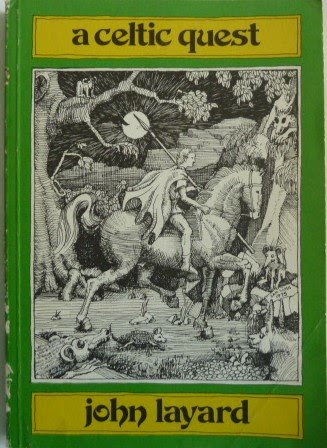
A Celtic Quest, by John Layard. A review of sorts.


A Celtic Quest. John Layard 1975.


In my last post I praised ‘This is not a Grail Romance’ for attempting to read a medieval story on its own terms. John Layard’s ‘A Celtic Quest; Sexuality and Soul in Individuation. A depth-psychology study of the Mabinogion legend of Culhwch and Olwen’ is a fine example of what happens when a critic does the opposite, taking a text and imposing a reading practice on it.


As a demonstration of a psychoanalytical meditation on a text, the book is fascinating. As one way of thinking about the development of an individual, it is coherent and thought provoking. But I think it would work best if you haven’t read the story it claims to be studying. 


As a reading of the text, rather than a performance that uses the text as a starting point, it doesn’t offer much in the way of critical enlightenment. It suffers from the author’s wide knowledge of what something might mean and his assumption that because something might mean something in another story, it means the same thing in this one. His willingness to shoehorn the story into an existing theoretical paradigm requires a willing suspension of incredulity on the part of any reader who isn’t a card carrying Jungian. 


Ironically  I suspect the book’s value may lie in forcing a reader to be patient and negotiate the tension between the reading and the text. The struggle to suppress the temptation to throw the book away, and find some useful insight into the story is salutary.


Firstly, a reader has to suppress the urge to object to statements like this:

 “’Born in a pig run’ is equivalent to being ‘born of a sow’ (p.11.).’ No. Simply, no, they are not. Culhwch’s mother is most definitely not a sow. 


Secondly. Anything can symbolise anything. Freud’s great perception about dreams was that the symbolism is always specific to the dreamer. This seems a useful way of approaching symbolism in stories. It’s not Layard’s. He is wedded to the idea of archetypes. He reads the story as though it could be neatly analysed and explained by recourse to an old fashioned book of dream symbols.


When Culhwch and his companions find Custennin the shepherd, the latter is sitting on a mound overlooking his limitless flock of sheep: 

‘…he is a man in the service of the Devouring mother, since in dreams and mythological imagery, the mound he stands on would seem to symbolise the breast’ (p.38)


At times this borders on self-parody. When Olwen’s father is finally beheaded and his head stuck on a stake; 

‘Another aspect of body imagery is that it may be that the mound symbolises the breast, with Ysbaddaden’s head on it  stake representing the ‘bad nipple’ . The hero seizes the good one ‘And he took possession of his fort and his dominions’.; the fort of the breast and the immense power it wields.’(p.198) 


With all due respects, this is hard to take seriously. There is nothing in the story to suggest ‘the fort of the breast’,  and this in a story where the storyteller delighted in playing with the potential absurdity of names.  Culhwch does not take possession of ‘the fort and his dominions'.  The ‘he’ in that sentence refers to another character, Goreu, who is also the one who beheads Ysbaddaden.


It feels as though symbolism is being found everywhere for the sake of finding symbolism with little reference to the story. When Cei murders Wrnach the Giant, having first tricked the giant into giving him his sword, Layard writes:


‘The scabbard here stands for the giant’s muddled head, into which Cei plunges the sword. The sword also symbolises the power of insight (the Logos) that pierces and destroys the blind forces of darkness (the blackness of the giant) or of the unconscious super-conservativism and resistance to change that giants are apt to represent.’ (p.102) 


Faced with such a reading it seems almost pedantic to point out that Wrnach is not described as black or back haired. But it does seem to be a worth asking how this applies to the story. Who gains what insight? Wrnach is dead, and Cei is about to leave the story in a fit of petulance after Arthur teases him. 


How the reading applies to the story is a constant question. Most readers will see Culhwch’s stepmother’s actions as wilfully (perhaps spitefully) putting him in danger. When she says he will not marry any woman unless it is Olwen, the phrase she uses  ‘ Tygaf tyghet’ is glossed by Bromwich and Evans as ‘I will swear a destiny’ and they point out the same phrase is used by Aranrhod, in the Fourth Branch of the Mabinogi,  when she swears her three [debilitating] destinies on her own son, Lleu. As Culhwch soon finds out, no one asking for Olwen’s hand has escaped alive. 


However, for Layard: ‘stepmother and fairy god mother are thus seen to represent two aspects of the same female spiritual principle, at first appearing to be 'bad’ but turning into the ‘good’. Such will be seen to the nature of the stepmother in this present tale, who in fact causes the hero to undertake all sorts of fearsome tasks so as, in the end, to win the prize most worth having, the spiritual bride or soul’.  (p.13). 


It feels pedantic, again, to point out that Culhwch doesn’t complete ANY of the forty tasks he’s given. Other people do it for him. He earns nothing, and learns nothing. He isn’t so much a non-hero as a non-presence in most of the story. The paradigms of the fairy tale or the ‘hero journey’ are not helpful here and what fairy godmothers and step mothers do in other tales seems irrelevant. 


These are not isolated or uncharacteristic examples but I think they demonstrate how a reading practice is being imposed on the text. 


Like most reading practices it also requires the reader to accept the critic’s assumptions: in this case those underwritten by a Jungian Binary, which in a simplified form, wants  to divide everything into two columns, one marked ‘male’ and the other ‘female’, regardless of gender or actions in a story. The Twrch Trwyth, the terrifying wild boar who slaughters men and devastates provinces, who can only be hunted by the mustered warriors of three kingdoms: 

..’is the image himself of nature outraged at having to be transformed, female in origin but in male guise to indicate its wild destructiveness’. (p.11) (The TT is a King who God has turned into a boar for his sins, and the aim of the hunt is not necessarily to  kill him, but to seize the comb, razor and sheers from between its ears.)


The binary is 19th century and to non Jungian acolytes completely arbitrary. Things are masculine or feminine because someone said they were. ‘Magic is always feminine” … and “…thought is a masculine attribute which women can have as well as men (witness the stepmother) once they admit the man as mate and not only as son’. (p.197)


Her husband is murdered so she can be the second wife of Culhwch’s widowed father. Her speeches in the text do not suggest ‘thought’ or that she has any attitude towards her new husband except relief to find he isn’t impotent.


Culhwch and Olwen is one of the world’s great literary performances. In its entirety it is like no other text. It is full of inconsistencies, and lacking in what a modern reader might expect in terms of character development and plot. It is not a fairy tale. But Leyard’s treatment of it as though it neatly illustrates a Jungian approach to Individuation, ignores the story itself and becomes an excellent example of what happens when a modern reading practice is imposed on a medieval text. 


Thursday, January 18, 2024

King's Champion. A Ballad of sorts.


This Is the companion piece to 'Taking Possession'. (See previous Post) First published in The Rotary Dial. I had been reading Percy's 'Reliques of Ancient English Poetry', one of those rare books that were influential in their own time and still readable today. I wanted to try a ballad style story, knowing that half the effect of such a form is lost if there is no tune and no singer.  I am also intrigued by the phenomena of trial by combat or ordeal. There is a story of William Marshall, the most famous knight in his day, being accused of treason by King John. The Marshall demanded he be given the right of trial by combat. Since no one was willing to face him, the charges were dropped. The same phenomena is evident in Malory's book, where Lancelot demands the right to prove the queen's innocence in single combat, despite the fact that everyone knows she's an adulteress. 
End of Prologue. 

King’s Champion.


1

The journey made, his duty done,

the invitation to remain was not refused

while winter raged and sulked 

about the castle walls. Humming  

a minor key in passages and towers 

the wind fumbled the tapestries.


Beside the brazier keeping watch 

on a land gone hard and white,

everything seemed dead 

or waiting to be born. Summer,

stories they remembered

for this stranger from the south 


who joins the winter games   
and watches m’lord’s daughter.  

Nothing to soften the darkness, 

until spring, then mounted, armed, 

into bright sunshine and bitter wind 

taking the princess to her wedding. 


2

The journey done, the prize delivered.

The king’s doubts laid to rest 

in private conversations: 

the land’s well-run, the castle’s sound.

So the wedding goes ahead

But first, obligatory festivities. 


He is the King’s Champion 

and he kills not for pleasure: 

it’s just what he does. On the first day

he won everything and all the women 

would have thrown their honour 

in the moat to be with him. 


On the second day he was undefeated. 

When the Princess smiled he fled, 

risked his life on the point of a spear 

and hurtled down the lists. 

On the third day the stranger came.

Wind tugged the bunting, swirling the dust.


His shield was black, his armour black

his herald, dressed in black, rode to the stands

saluted the young King, and said:

My master says: this woman is my wife.

She is no maid. He claims his right

to prove this truth in combat.


The King called for his Champion: 

You lied! You found the rumour true: 

a Knight came courting for his Lord 

and won the Lady’s heart instead. 

You will defend the honour 

of this woman I must marry. 


Your skill must prove her purity

stainless as the robes she’ll wear 

on coronation day. And if you fail, 

I’ll feed them to the royal pigs.  


3


Spears shatter, horses buckle, 

scrambling clear they pound away. 

His enemy anticipates each stroke. 

But he predicts the Knight’s attempts. 


A mirror image of himself,   

who tip-toed passageways 

who risked the terrifying consequence

and wanted his reward. 


They paused. Leant on their swords.

Blood dripping on the troubled dust. 

All summer long I had her, gasped the Knight.

We plighted troth. I am her spouse. 


I know you did, the Champion replied,

and that is neither here nor there.

Her father won’t acknowledge you:

he wants a grandson on the throne.


My master was impatient.

he proved if she were maid  

the first night that she came 

and that is neither here nor there.


He needs her father’s castle

his lands, his loyalty, his men 

to keep the northland settled

at this stage of his reign.


What matters is not

the truth of your claim

but this ritual proof

we both know proves nothing.


He had not trained to parry words.

Edge striking battered metal 

slashes the knight’s head from his body.

The Champion paused to breathe, 

and bleed, then straightened up

and turned to the applause 


The King and Princess came in finery

to stand above the metal and the meat. 

A royal gesture had it dragged away: 

blood spatters on the Ermine 

from the puddles round her dainty feet.

He took her hand. Gentles, the liar shamed

tomorrow this false-slandered lady 

shall become your Queen and mine.