Showing posts with label The Mabinogion. Show all posts

Monday, April 27, 2026

Review of How Culhwch won Olwen: a verse translation of the oldest Arthurian tale


The review concludes.


'Guilar’s reimagining of the story of Culhwch and Olwen blows away the cobwebs and allows us to read this classic work of medieval Welsh literature and foundation stone of the Arthurian cycle with fresh eyes. It’s a triumph.'


The full review is here. 

https://ellipticalmovements.wordpress.com/2026/04/27/celtic-matters/


Along with a review of Book of Inversions, Kit Fryatt & Harry Gilonis,  which sounds fascinating.

Wednesday, December 10, 2025

A new translation of Culhwch and Olwen, the Oldest Arthurian Tale


My verse translation of Culhwch ac Olwen. the Oldest Arthurian Tale, will be published by Shearsman in the UK in January 2026. 

Information about the book as well as samples can be found on their website.

https://www.shearsman.com/store/Liam-Guilar-trans-How-Culhwch-Won-Olwen-p767786031 


The original medieval Welsh story is not only the oldest surviving story involving Arthur, but one of the great literary performances. Information on this blog about the story, and links to sections that have been published online, can be found by clicking the Culhwch and Olwen label below or looking for the same on the left hand menu. 

Wednesday, January 22, 2025

Translating Culhwch and Olwen, final thoughts.

And as long as he lived, she was his only wife


I love this story, I have known it for decades. I wouldn’t like to live in it.   


Translating it, I have become very pro-giant and sympathetic to boars and witches. I doubt this was the storyteller’s intention, although he obviously admired a good horse and dog, and knew the boar was a worthy opponent. 


The material probably felt archaic when it was written down. Throughout the story there is an indifference to suffering, stripped of all pretence of ideological or theological justification. In a world of talking animals and men who have been punished by being turned into animals, the distinction between humans and other animals is slight. Twrch Trywth, the great boar, and his piglets are as brave and as admirable as the heroes who hunt them. Men kill without remorse or compassion. They throw their lives away with flamboyant indifference. To get two strangers into bed, the death toll is enormous and nobody questions this, at any point in the story. 


Those outside courtly society; giants and witches, or those in possession of desired objects, are there to be used, exploited, and killed. The powerful will take what they want or need. They might ask first, but ‘no’ is never a safe option. 


It's a story, nothing more or less. But perhaps the storyteller understood that stripped of pretence, this is the way the world has always worked. He doesn’t condone or condemn. He reports. Ysbadadden, shaved and about to die, speaks the truth. Culhwch has earned nothing; learnt nothing. Without Arthur, he didn’t have a chance. 

‘And that’ says our author, ‘is how Culhwch won Olwen.’ 


A Presentment of Englishry, A Man of Heart, The Fabled Third


I started writing these ten years ago and now they are finished and I can hear the Grateful Dead singing; 'What a long strange trip it's been'.


Narrative poetry, or Historical fiction, or historical fiction in verse. I think of it as storytelling, 


From a prehistoric tin trader visiting the island to the struggle for power at the end of Roman Britain and the coming of the English.


The stories of Locrin, Gwendoline and Aestrild; Vortigern and Rowena; and Uther and Ygrayne are taken from Laȝamon‘s late twelfth century version of the legendary history of Britain. The Fabled Third also contains versions of three stories from The Mabinogion. 


Laȝamon‘s own story is sketched in A Presentment of Englishry and he returns to close the books at the end of The Fabled Third in Laȝamon‘s Last Interview. 


Information and samples on Shearsman UK’s website, Information, Samples and background at  www.liamguilar.com.    


Nu biddeð Laȝamon alcne æðele mon;

for þene almiten Godd.

þet þeos boc rede; & leornia þeos runan.

þat he þeos soðfeste word; segge to-sumne.

for his fader saule; þa hine forð brouhte.

& for his moder saule; þa hine to monne iber.

& for his awene saule; þat hire þe selre beo. Amen

Wednesday, January 15, 2025

The Fabled Third is now published


The Fabled Third is now available directly from the publisher: Click Here  and from the usual online outlets. Take advantage of a weak Australian Dollar and buy direct from my website: Click Here where you will also find samples and background information.

Summary.

Following the outline of Laȝamon the priest’s late twelfth century version, The Fabled Third is the story, in verse, of Uther Pendragon’s attempt to rule what’s left of the Roman province of Britannia in the late 5th /early 6th Century. His British subjects are more interested in squabbling over their privileges than in working together against the increasing numbers coming to plunder the ailing province. 


Gorlois Duke of Cornwall, a survivor of the previous regime, resents Uther, is resistant to royal authority and is looking for an excuse to renounce his oath of allegiance and go to war. An equally resentful Merlin, banished from the court, is plotting his revenge.  


The women are caught in a struggle for precedence and power, knowing the consequences of failure are horrifying. Ygrayne, the wife of Gorlois, has seen what happens to the wives of defeated rulers. Knowing that her husband can’t beat Uther, she too is plotting. 


The book begins when Gwydion, a British storyteller, arrives at Uther’s court. Uther is in need of a bard. He challenges Gwydion to tell three stories, for three different audiences.  Versions of Gwydion’s stories will later be collected in ‘The Mabinogion’ but as he becomes involved in Uther’s struggle to rule the province, the first two stories are easy. 

The third is the problem. 

Friday, December 13, 2024

Translating Culhwch and Olwen.


The Lunt Roman fort at Bagington. 

Translating Culhwch and Olwen.

First time


There’s a first time for everything.

But I don’t know 

when I first read 

or heard this story. Or why,

of all the things that it contains

the porter and his words

were what remained. 


I read the Jones and Jones translation.

My yellowed copy still provides 

the necessary gloss when 

ny bo namyn iawn iawn 

turns to alphabet spaghetti in my head. 


Perhaps, the creaking wooden gatehouse

of the reconstructed Lunt at Bagington. 

Imperial Rome’s repressive architecture 

to keep the beaten Britkins in their place.

The structure shaking in the wind,

I stood upon the shifting platform,

and could imagine Great Grey Mighty Grasp

looking down on stroppy Culhwch

with his horse and dogs. 


And the sound of Stival’s harp,

borrowed from the record library, 

(I liked the cover) 

weather and wild landscape. 

blowing through the speakers.


In a storm of cliches. 

I heard grey tide on the gravel beach

saw sunshine off the cliffs, heard wind and rain

smacking the slate in the green hills

and watched the grey rock changing colour as it dried.

I saw men in cloaks, with swords, 

standing on a cliff edge

looking at a longship rocking out beyond the surf. 

Renassiance De La Harp Celtique. 

But as I read, the cliches were replaced. 

Now the porter’s scene’s in shadow,

it’s raining, and the sound of harp and drum

comes softly from the distant, well-lit hall.


Tuesday, December 10, 2024

Publication: The Fabled Third.


 P

Photos are what happen when you need a break from the seriousness of proof reading the final proof copy.

The Fabled Third, the last instalment in the run of books that began with A Presentment of Englishry, will be published by Shearsman in the UK in January 2025. Details and samples on the publisher's website.

https://www.shearsman.com/store/Liam-Guilar-The-Fabled-Third-p673705296

Tuesday, October 15, 2024

Translating Culhwch and Olwen; The Great Boar Hunt and David Jones

The hunting of the great boar, Twrch Trwyth, in Culhwch and Olwen is a magnificent piece of writing. 


Jones' The Hunt is not so much a translation as a response, and it too is magnificent.


I have finished the first draft of my translation. Olwen and Culhwch are sleeping together, Ysbadadden's shaved and mutilated head is on a stick, possibly visible from their bedroom window, and no one could tally the men who have died to bring about this ending. 


Arthur gathered the hosts, 

of the three Islands of Britain,

and the three adjacent islands, 

and of Brittany, Normandy, 

and the Summer country


And let it be proclaimed,

the hunting of the hog,

has been sung by David Jones

and neither Taliesin nor Aneirin

nor Dafydd ap Gwilym himself

The Early Bards, 

the Not So Early bards, 

the Poets of the Princes, 

the Poets of the Well to Do

the keepers of old lore, or

the skilled translators of his vanished tongue,

(loving this story in elegant prose translations)

nor modern experts in the intricate cynghanedd 

nor any poet of that other language,

could sing it better. 


My recording of The Hunt by David Jones is here:

http://www.liamguilar.com/the-poetry-voice/2019/4/2/david-jones-the-hunt


There’s a recording of David Jones reading The Hunt with a short introduction here:

https://bebrowed.wordpress.com/2014/03/17/david-jones-reads-the-hunt/


Friday, September 27, 2024

The tasks in Culhwch and Olwen. When is repetition excessive in a poem?

The Anoethau in Culhwch and Olwen[i]


This is the second problem sequence I’m working through.  (See previous post for the first.)


In Culhwch ac Olwen, the Giant Ysbaddaden gives Culhwch forty impossible tasks which are referred to by the editors and within the text as Anoethau[ii]


After Ysbaddaden stipulates the first task, Culhwch replies:


Hawd yw gennyf gaffel hynny, yd tybyckych na bo hawd. 

It is easy for me to get that, though you may think it is not easy.


Ysbaddaden responds:


Kyt Kffych hynny, yssit ny cheffych.

Though you may get that, there is something you will not get. 

( translations here are Sioned Davies'. )


Each subsequent task is wrapped by these lines. So both phrases are repeated approximately forty times, which is repetition driven to excess. Would it be too much to ask of a modern reader? 

If anyone knows of a poem that repeats the same 2 lines forty times or more, I’d like to read it. 

I was tempted to cut the list of tasks down to only those which are actually performed in the story, roughly ten of them.


However. 


Perhaps anachronistically, we can see the dialogue that develops in dramatic terms. It is a clash between two characters who have irreconcilable objectives. As a result of this exchange, one of them must die.  


Culhwch knows he will never marry anyone except Olwen. He’s been told several times that most men who come on the quest to marry her have been killed. 


During their brief meeting, Olwen gave him some advice. Ask for my hand in marriage. Whatever he asks in return, promise you’ll get it. But if he has cause to doubt you, me you won’t get and you’ll be lucky to escape with your life. 


Both Culhwch and Ysbaddaden know the latter will die when his daughter gets married. He is understandably inhospitable to any suitor. For unstated reasons, he seems compelled to enter into a contract with the suitor and offer him the opportunity to complete an impossible task. If the suitor flinches or fails, the giant can kill him.


So there is obvious conflict. It’s a ‘high stakes’ confrontation. 


The dialogue begins with Ysbaddaden stating an obvious impossibility. He wants a field cleared, ploughed, sown and the resultant crop reaped all in one day. Instead of protesting, Culhwch, says: It is easy for me to get that, though you may think it is not easy


Perhaps wondering if the boy has understood, the giant then explains why it is impossible: you need this man to prepare the field, he won’t do it of his own free will, and you can’t make him. Culhwch repeats his phrase. You also need this man to fix the plough and he won’t come and you can’t make him. And Culhwch, like a naked man in a hailstorm, refusing to flinch, repeats: It is easy for me….


And so on. Things needed for the wedding feast; things needed to prepare and shave his beard; dogs, people, horses and things needed to hunt the Twrch Trwyth.


Ysbadadden keeps going, waiting for the boy to crack, and Culhwch stands his ground and repeats the same response. He’s hiding behind it because, of course, he can’t  achieve any of these things. He's just a pretty rich boy with bad manners and shiney tools.


As the boy refuses to crack, Ysbaddaden must see his own death coming towards him like a slow train on a very straight track over a very flat landscape 


He plays his final card. It’s obvious the boy can’t do any of these things on his own. 

You need Arthur and his men to hunt the great boar. And he won’t come, because he’s my man. (The phrase  is ‘he’s in my hand’). 


But Culhwch still refuses to flinch, still repeats his mantra. The giant, running out of ideas,  reaches for absurdity, a desperate explosion of nonsense. He’s been pounding away, and now he must realise that he’s been punching the side of a mountain. 


Though you get all that, there’s something you won’t get. 

The Twrch Trwyth will never be hunted unless you obtain 

Defective, Perfected and Completed, 

sons of Broken Sword, grandsons of Perfect Sword

Three shining whites their shields

Three stabbing piercers their spears

Three keen carvers their swords

Their three dogs: Silver, Salmon and Smoky

Their three horses: Sharp, Speedy and Steed

Their three wives: Late Bearer, Ill Bearer and Full bearer

Their three crones: Alas, Scream and Shriek

Their three serving girls: Bad, Worse and Worst of all.

These three men will sound their horns, 

And all the others will cry out,

so no one will care if the sky falls in. 

I can get that easily enough, although you seem to think I can’t.

 (My translation. As are what follows.)


Ysbaddaden makes one final attempt, saying what they both know:


Sleeplessness without rest you will get in seeking these things, 

and you won’t get them, and you won’t get my daughter.  


But Culhwch, who has already shown he’s not the most tactful or polite of young men, now sticks the boot in:


Horses and hounds I will get. 

And Arthur, 

my Lord and Kinsman, 

will get everything for me. 

And I will have your daughter, 

and you shall lose your life.


I’m becoming very pro-giant. 

I think the dialogue has a structural coherence and a dramatic context, but whether that underlying drama is strong enough to carry a modern reader through the repetition  remains to be seen. 


[i] (When I started working through the Tasks I read this  essay, which seems to suggest a similar approach. Dehghani, Fiona. “The Anoetheu Dialogue in Culhwch Ac Olwen.” Proceedings of the Harvard Celtic Colloquium, vol. 26/27, 2006, pp. 291–305. JSTOR, http://www.jstor.org/stable/40732062.)

[ii] GPC offers: wonderful thing, wonder, jewel, treasure; something difficult to obtain or achieve, feat, exploit; wondrous, wonderful, strange, unusual, ?difficult. 


Saturday, September 14, 2024

The Court List in Culhwch ac Olwen. What is relevance?

Translating the Court List.


(Quotations from the story are from Will Parker’s Translation: http://www.culhwch.info/index.html)


When I began translating Culhwch and Olwen into verse, I knew that my three biggest challenges would be the Court List, the List of Tasks, and the Great Boar Hunt. My problem is to find a way to overcome the challenges they will present to my ‘Model Reader’ who doesn’t read Medieval or Modern Welsh. 


My initial idea was to shorten the Tasks to only those which occur in the story, cut the Court List altogether and keep the hunt to a minimum.

I’m changing my mind about all three.


The Court List: 


Reasons to cut it.


The temptation to cut the list is strong. It’s essentially a list of names, with attributes attached to some of them. It runs for four pages or two hundred lines in the Bromwich and Evans edition I’m using. The editors count ‘about 260’ names. It begins like this:


he invoked his boon [in the name of] Cai and Bedwyr and Greidol Gallddofyd and Gwythyr son of Greidol and Graid son of Eri and Cynddylig Gyfarwydd and Tathal Twyll Golau and Maelwys son of Baeddan and Cnychwr son of Nes and Cubert son of Daere and Ffercos map Poch and Lluber Beuthach and Corfill Berfach.


If you can’t read Welsh, the obvious problem is pronunciation. 260+/- names that look as though someone spilt alphabet spaghetti on the page. But not only might the pronunciation of Sucgyn mab Sucnedut trip you up, unless you know it means Suck son of Sucker, the humour of the list is lost. 


Bromwich and Evans, discussing the list, suggest. ’But if the whole series of names between lines 175-373 is excised, the tale runs on with greater clarity and smoothness: line 174 being followed immediately by line 374.’ They are right,  of course:


"[The boon] I name is for you to get me Olwen, daughter of Yspaddaden Bencawr, and I invoke it [in the name of] your warriors."

[Delete 200 lines of text]

‘Arthur said "O Chieftain, I have never heard about the maiden of whom you speak, nor her parents. I will send out messengers to search for her gladly." 


Reasons to Include the List:


 Plot isn’t everything. Deciding on what is relevant to a story is not a straight forward process regardless of what your editor claims. Relevant to your reading or mine or to a possible reading neither of us have made? James Joyce and Umberto Eco would have loved it. So what might it add to the story?


The court list demonstrates the extent of Arthur’s power. It contain men from France, Ireland, Brittany and the Uplands of Hell, as well as bishops, kings and the sons of kings. It contains historical figures, euhemerised characters from earlier myth,  and figures from other story cycles. 


Arthur’s court might be impressive, but we know it falls and the list forcibly reminds us of this by referring to the battle of Camlan. We meet one of the nine men who planned the battle,  and the three men who escaped and Arthur isn’t one of them. Even the mention of Gwyhenever and her sister alludes to the fact that, according to the Triad, Camlan was the result of her sister hitting the queen. There is also the man who will kill Kei, who Arthur will kill in revenge.


The absurd qualities of some of the heroes are exaggerated exaggerations: the kind I‘d heard growing up: he could eat you out of house and home; he drinks so much his legs must be hollow; he can talk the hind legs off a donkey. So they don’t feel as alien as they might and I enjoy them. But the fact that so many of these names have special skills or qualities, even when the skills and qualities are absurd, emphasises the fact that Culhwch has nothing going for him other than his fine horse, his shiny weapons, and his bad manners. He is out of his depth even before Ysbaddaden stipulates 40 Impossible Tasks. 


The list also reinforces the fact that neither Culhwch nor reader, nor the original audience, are in familiar territory anymore. Once Culhwch has been greeted by the porter we’ve entered a very strange version of the world. There will be giants and witches and talking animals, as well as people who God transformed into animals for their sins. By the time you get to the end of the court list, the relative sanity of the opening of the story with its folk tale style familiarity is easily forgotten. The list acts as a portal that normalises the rest of the story. Once we've passed through it, nothing that follows seems strange. 


You can also feel the story teller working the audience. As he launches into the list, the audience would tense. How long will this go on for? But they will never know what comes next, if it’s serious or ludicrous, and the variation carries them through the surging rhythms of the list. It’s an essential part of the performance that is this story. 


The ‘silly names’ in the list also remind of us of two things. Firstly, there was a time when names did mean something. In this context, making up names has a currency. Secondly, real people had names that to us sound strange. To just take a random example from a book on Medieval Hunting (by John Cummings):  Jehan Corneprise’ (John blow the death), Jehan Ievre (John Hallo-the-hare) and Huelguillot le Mastiner (Guillot the mastiff man.) (the translations are Cumming's).


A similar list of names in Apollonius of Tyre’s poem on the Argonauts is a dull catalogue. The list in Culhwch is varied, entertaining and if not laugh out loud funny often amusingly demented


Given it does so much according to my reading of the text, it seems worth the risk that it might alienate my non Welsh speaking Model Reader. The Court List stays. Whether in slightly abbreviated form or in full remains to be seen. 


Saturday, August 31, 2024

Is this how Genre works? The tale of the oldest animals in Culhwch and Olwen.

 (Ongoing notes from an attempt to translate Culhwch ac Olwen from medieval Welsh to modern English and from prose to verse. See previous post for an example. )

In 'Culhwch and Olwen' there's the 'Tale of the Oldest Animals' which I've just finished drafting. You have to accept animals can talk and people will understand them. But....the story itself...

Arthur and his men need to find Mabon mab Modron. To do this, they have been told that first they have to find his cousin, Eiddoel mab Eri. They find Eiddoel easily enough, he's being kept prisoner in a place called Gliui by someone with the same name.

Gliui is identified by the editors as Gloucester. Fair enough. Later, after a trek from one 'Oldest animal' to an 'Even older animal' our heroes discover Mabon is being held prisoner in Kaer Loyw, which the editors also identify as Gloucester. 


So they free Eiddoel from the same place they free Mabon, though they go round the Wrekin to achieve this. 

Does genre work by setting up a tacit bargain with the reader: Some questions are inappropriate? If for general example, you're reading the Grimm's version of Snow White you should not stop and ask what the prince is going to do with the dead girl in the glass coffin when he gets it home. Nor should you try and imagine his arrival at the palace and his parents' reaction. It will kill the story.

Inappropriate, unanswerable questions here?

How can they both be prisoners in the same place? Who is keeping Mabon prisoner? Presumably it’s not Gliui because he's offered Arthur his help and support? Was he lying? Is Arthur at fault for not asking if Gliui knows where Mabon is? Why do they assume that 'No one knows where Mabon is' means 'Don't ask anyone except an animal'? Why does no-one on the river hear Mabon lamenting?  Why have they been told they needed Eiddoel to find Mabon when he is sent on the search but contributes nothing to it? 

Why is the episode so satisfying and enjoyable until you start asking these questions? And this is true of so much of Culhwch ac Olwen


Are we back with a specific version of Culler's 'Literary Competence'. The idea that you have to learn to read a literary text as a literary text on its own terms? And with this story, that means not trying to read with a modern set of assumptions based on a learnt 'Literary competence' for dealing with modern short stories or novels? 

Thursday, August 22, 2024

Translating 'Culhwch and Olwen'. Giants, ants and perplexing verbs.

 These poems were first published in The Brazen Head


https://brazen-head.org/2024/08/19/three-translations-from-culhwch-ac-owen/


(I.m Michael Alexander)


Translating Culhwch ac Olwen.


In popular films the sexy treasure hunter/archaeologist

(they conflate the two, much to my trowel wielding friends’ dismay)

who’s fluent in every lost forgotten ancient language,

confronting the inscription on the recently uncovered wall,

or gazing at the long lost rediscovered legendary text,

looks, then translates, without a pause, the symbols 

into fluent, idiomatic, contemporary American.


The reality goes more like this:


Kilyd son of Kledon Wledic

Wanted a wife as noble as himself.

Here is the woman he wanted.

Goleudyt daughter of Anlawd Wledic.


So far so good. 


After they stayed together What? Gwest Ah, see note.

They spent the night together. Is that too direct?

The verb’s related to the one for copulation. 

They came together. After they were married

….bland. After they slept together,

no, the story teller could have used kysgu gan.

The cruder options? No. Not here. What follows? 


The country went to pray they ?might have? offspring

And they got a child/boy through the prayers of the country.

And from the hour she captured, caught? 

The next word’s definitely ‘pregnant’. Another note. 

‘Became pregnant’ though literally ‘caught pregnancy’.

As though it were an illness, perhaps better than ‘fell pregnant’

which evokes abrupt decline, or woman, falling?

Then she went wild/feral. Another note.

‘She went mad’. Mad or wild is somewhere you go to

in this case beyond the civilised boundaries.

She’s gone mad and won’t come near a building.

Wouldn’t enter a building? 


And from the time that she was pregnant, 

She went wild and wouldn’t enter any building.

And when her time came, she came to her good sense.

You go mad but come to your senses. The payoff’s here,  

the sudden twist estranging your own language.

You go out of your mind as though it were a car, 

and you could leave it in the car park to return to 

when finished being mad and needed it again. Anyway, 

what’s next? Pigs!? What? We’re up to line 7, only 

one thousand two hundred and thirty eight to go.


May I marry your daughter?


(The giant Ysbaddaden Pencawr knows he will die when Olwen, his beautiful daughter, marries. Understandably, he doesn’t welcome her suitors. But Culhwch has been told that if he doesn’t marry Olwen, he will never marry anyone. He and his six companions set out to ask the giant for her hand in marriage.What isn’t stated but becomes obvious is that the giant can’t be killed until his daughter is married. )


They killed the nine gatekeepers, 

and not a man cried out.

They killed their nine huge mastiffs;

not one so much as squealed.

And so they came into the hall.


‘Ysbaddaden Pencawr! Greetings

in the name of God and man!’


‘You, where are you going?’


‘We seek your daughter, Olwen,

for Culhwch son of Kilyd.’


‘Where are those rascal servants?

Where are those ruffians of mine?

Raise up the forks under my eyelids

so I can see my future son in law.’


This they did. ‘Come back tomorrow 

I’ll have an answer for you then.’


He had three stone spears beside him,

each tipped with poison.

As they turned to go he seized one 

and flung it after them.

Bedwyr caught it and hurled it back,

piercing the giant through his knee cap.


‘Cursed savage son in law! 

It will be worse for me when I go downhill.

Like the sting of a gadfly, 

the poisoned iron has hurt me.

Cursed be the smith who made it 

and the anvil on which it was forged.‘                  


They stayed that night at Custennin’s house.

And on the second day, they set out to the hall, 

in majesty, with fine combs in their hair.


‘Ysbaddaden Pencawr, 

give us your daughter.

In return for her dowry and marriage fee 

to you and her two kinswomen.

And if we don’t get her from you;

you’ll get your death from us.’


‘Her four great-grandmothers 

and her four great-grandfathers 

are still alive. I must consult them.’ 


‘You do that. We’ll go eat.’


He took the second spear 

and hurled it after them.

Menw mab Teirgwaedd 

caught it and threw it back. 

It pierced the centre of his chest 

and sprung out the small of his back.


‘Cursed savage son in law.

The pain of this hard iron

is like the sting of a horse-leech. 

Cursed be the forge wherein it was heated.

Now, when I go uphill, 

there will be a tightness in my chest,

stomach aches and frequent nausea.’  


They went to their food.


On the third day they came to the court.

‘Ysbaddaden Pencawr, 

stop throwing spears at us.

Do not wish hurt and harm 

and death upon yourself.’


‘My eyelids have fallen over my eyeballs-

Where are my servants, raise up the forks

so I may look on my future son in law.’


They arose, and as they rose,

he took the third spear

and hurled it at them. This time, 

Culhwch caught it and threw it back,

and as he wished, it pierced the eyeball 

went through and out the back of his neck.


‘Cursed savage son in law.

As long as I live the sight in one eye 

will be worse than the other.

Whenever I walk in the wind it will water.

I’ll have headaches and giddiness 

at the start of each moon.

Cursed be the forge that heated it. 

Worse than the bite of a mad dog 

is the sting of its poisoned iron.’


Next day they came to the court.

‘Don’t attack us anymore.

You’ll bring hurt and harm 

and martyrdom to yourself.

Give us your daughter.’


‘Which one of you was told to seek her?’

‘Me, Culhwch, son of Kilyd.’

‘Come here so I can see you.’ 

A chair was placed under him, 

so they could be face to face.


‘Is it you who seeks my daughter?’

‘I do.’ ‘Give me your word 

that you’ll be just?’ ‘I give it.’

‘When you give me what I name, 

then you will have my daughter.’ 

‘Name what you want.’


-------------- 


(Ysbaddaden gives Culhwch forty impossible tasks. This next poem tells how one of them is achieved. Gwythyr is one of Culhwch’s companions.)


The Lame Ant


As Gwythyr mab Greidawl 

was crossing a mountain, 

he heard lamentations:

a most bitter wailing.


Dreadful this noise.

He rushed towards it

drawing his sword, 

cutting the anthill 

off at the ground

saving the ants from

the blistering flames.


‘God’s blessing and ours upon you,’

they said to him.

‘And that which no man can recover

we will recover for thee.’


These were the ants 

who collected the flax,

all the nine hestors

Ysbaddaden demanded.


But one seed was missing.

Until just before sunset.

it was finally brought in

by the last, limping ant. 


Friday, July 12, 2024

Translating Culhwch and Olwen. (publication)


I've been translating the story of Culhwch and Olwen, a medieval Welsh tale. It's usually flagged as 'the oldest surviving story of King Arthur.' My aim  is to translate medieval Welsh prose into a modern English verse sequence.  You can read the first published attempts by clicking on the link below which will take you to David Cooke's The High Window where you'll find many other excellent things.  

 Seven extracts from Culhwch and Olwen

Thursday, May 9, 2024

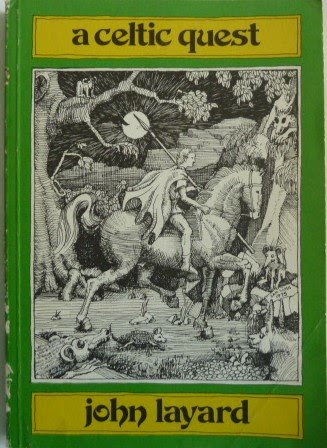
A Celtic Quest, by John Layard. A review of sorts.


A Celtic Quest. John Layard 1975.


In my last post I praised ‘This is not a Grail Romance’ for attempting to read a medieval story on its own terms. John Layard’s ‘A Celtic Quest; Sexuality and Soul in Individuation. A depth-psychology study of the Mabinogion legend of Culhwch and Olwen’ is a fine example of what happens when a critic does the opposite, taking a text and imposing a reading practice on it.


As a demonstration of a psychoanalytical meditation on a text, the book is fascinating. As one way of thinking about the development of an individual, it is coherent and thought provoking. But I think it would work best if you haven’t read the story it claims to be studying. 


As a reading of the text, rather than a performance that uses the text as a starting point, it doesn’t offer much in the way of critical enlightenment. It suffers from the author’s wide knowledge of what something might mean and his assumption that because something might mean something in another story, it means the same thing in this one. His willingness to shoehorn the story into an existing theoretical paradigm requires a willing suspension of incredulity on the part of any reader who isn’t a card carrying Jungian. 


Ironically  I suspect the book’s value may lie in forcing a reader to be patient and negotiate the tension between the reading and the text. The struggle to suppress the temptation to throw the book away, and find some useful insight into the story is salutary.


Firstly, a reader has to suppress the urge to object to statements like this:

 “’Born in a pig run’ is equivalent to being ‘born of a sow’ (p.11.).’ No. Simply, no, they are not. Culhwch’s mother is most definitely not a sow. 


Secondly. Anything can symbolise anything. Freud’s great perception about dreams was that the symbolism is always specific to the dreamer. This seems a useful way of approaching symbolism in stories. It’s not Layard’s. He is wedded to the idea of archetypes. He reads the story as though it could be neatly analysed and explained by recourse to an old fashioned book of dream symbols.


When Culhwch and his companions find Custennin the shepherd, the latter is sitting on a mound overlooking his limitless flock of sheep: 

‘…he is a man in the service of the Devouring mother, since in dreams and mythological imagery, the mound he stands on would seem to symbolise the breast’ (p.38)


At times this borders on self-parody. When Olwen’s father is finally beheaded and his head stuck on a stake; 

‘Another aspect of body imagery is that it may be that the mound symbolises the breast, with Ysbaddaden’s head on it  stake representing the ‘bad nipple’ . The hero seizes the good one ‘And he took possession of his fort and his dominions’.; the fort of the breast and the immense power it wields.’(p.198) 


With all due respects, this is hard to take seriously. There is nothing in the story to suggest ‘the fort of the breast’,  and this in a story where the storyteller delighted in playing with the potential absurdity of names.  Culhwch does not take possession of ‘the fort and his dominions'.  The ‘he’ in that sentence refers to another character, Goreu, who is also the one who beheads Ysbaddaden.


It feels as though symbolism is being found everywhere for the sake of finding symbolism with little reference to the story. When Cei murders Wrnach the Giant, having first tricked the giant into giving him his sword, Layard writes:


‘The scabbard here stands for the giant’s muddled head, into which Cei plunges the sword. The sword also symbolises the power of insight (the Logos) that pierces and destroys the blind forces of darkness (the blackness of the giant) or of the unconscious super-conservativism and resistance to change that giants are apt to represent.’ (p.102) 


Faced with such a reading it seems almost pedantic to point out that Wrnach is not described as black or back haired. But it does seem to be a worth asking how this applies to the story. Who gains what insight? Wrnach is dead, and Cei is about to leave the story in a fit of petulance after Arthur teases him. 


How the reading applies to the story is a constant question. Most readers will see Culhwch’s stepmother’s actions as wilfully (perhaps spitefully) putting him in danger. When she says he will not marry any woman unless it is Olwen, the phrase she uses  ‘ Tygaf tyghet’ is glossed by Bromwich and Evans as ‘I will swear a destiny’ and they point out the same phrase is used by Aranrhod, in the Fourth Branch of the Mabinogi,  when she swears her three [debilitating] destinies on her own son, Lleu. As Culhwch soon finds out, no one asking for Olwen’s hand has escaped alive. 


However, for Layard: ‘stepmother and fairy god mother are thus seen to represent two aspects of the same female spiritual principle, at first appearing to be 'bad’ but turning into the ‘good’. Such will be seen to the nature of the stepmother in this present tale, who in fact causes the hero to undertake all sorts of fearsome tasks so as, in the end, to win the prize most worth having, the spiritual bride or soul’.  (p.13). 


It feels pedantic, again, to point out that Culhwch doesn’t complete ANY of the forty tasks he’s given. Other people do it for him. He earns nothing, and learns nothing. He isn’t so much a non-hero as a non-presence in most of the story. The paradigms of the fairy tale or the ‘hero journey’ are not helpful here and what fairy godmothers and step mothers do in other tales seems irrelevant. 


These are not isolated or uncharacteristic examples but I think they demonstrate how a reading practice is being imposed on the text. 


Like most reading practices it also requires the reader to accept the critic’s assumptions: in this case those underwritten by a Jungian Binary, which in a simplified form, wants  to divide everything into two columns, one marked ‘male’ and the other ‘female’, regardless of gender or actions in a story. The Twrch Trwyth, the terrifying wild boar who slaughters men and devastates provinces, who can only be hunted by the mustered warriors of three kingdoms: 

..’is the image himself of nature outraged at having to be transformed, female in origin but in male guise to indicate its wild destructiveness’. (p.11) (The TT is a King who God has turned into a boar for his sins, and the aim of the hunt is not necessarily to  kill him, but to seize the comb, razor and sheers from between its ears.)


The binary is 19th century and to non Jungian acolytes completely arbitrary. Things are masculine or feminine because someone said they were. ‘Magic is always feminine” … and “…thought is a masculine attribute which women can have as well as men (witness the stepmother) once they admit the man as mate and not only as son’. (p.197)


Her husband is murdered so she can be the second wife of Culhwch’s widowed father. Her speeches in the text do not suggest ‘thought’ or that she has any attitude towards her new husband except relief to find he isn’t impotent.


Culhwch and Olwen is one of the world’s great literary performances. In its entirety it is like no other text. It is full of inconsistencies, and lacking in what a modern reader might expect in terms of character development and plot. It is not a fairy tale. But Leyard’s treatment of it as though it neatly illustrates a Jungian approach to Individuation, ignores the story itself and becomes an excellent example of what happens when a modern reading practice is imposed on a medieval text.